Wednesday, 30 June 2010

Dunning Golf Club - course no 314

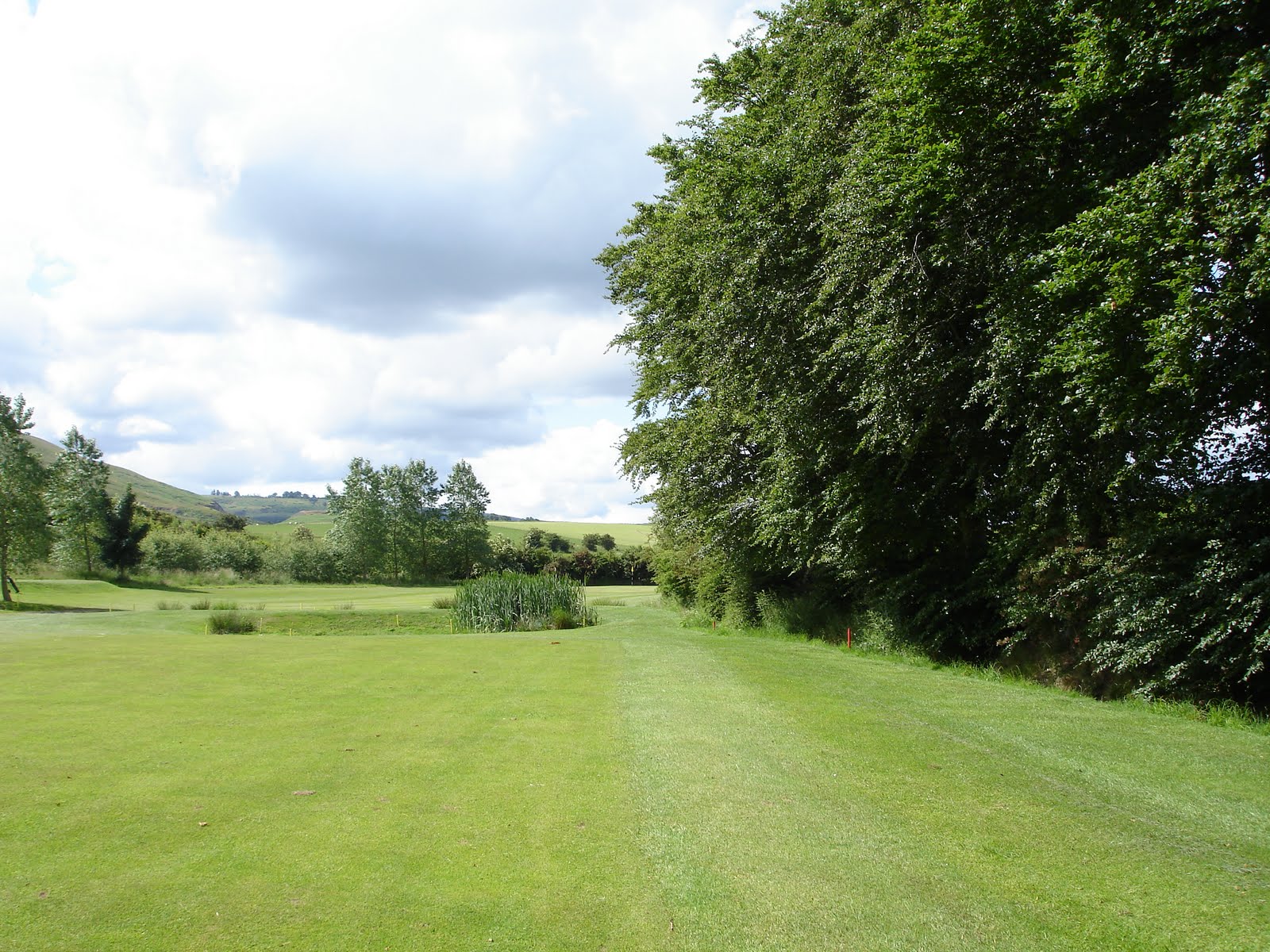
I played this short 9 hole, 2199 yard (off the yellow tees) par 33 course on 29 June 2010 after my round at nearby Whitemoss. Dunning is generally pretty flat apart and is a very easy walk. This is the 1st hole, a drivable par 4 of only 252 yards. As at Whitemoss, I hit a tree but managed a par with a good single putt. I almost went out of bounds on the long par 3 2nd after a sliced 3 wood but ended up completely stymied by a tree (take me back to links courses!) and ended up with a double bogey. The 3rd was a silly short 242 yard par 4, protected only by bunkers to the front left of the green. I found a bunker but still parred the hole, but was less lucky on the 4th and 5th, where bunkers cost me a bogey each time.

I thought the 6th was Dunning's best hole and a worthy Stroke Index 1. At 311 yards, it's actually the longest hole on the course and is a gentle dog leg left, slightly uphill. The second shot is completely blind, with trees, bushes and out of bounds immediately behind the green. I hit an easy 9 iron to 15 feet short of the hole, but missed the birdie putt. By then I'd caught up with a couple of local members and spent a few minutes practising my putting. The green slopes upward from front to back and from above the hole was scary fast, so I guess being short of the hole was the right play.


I also found bunkers at the 7th and 8th for further bogeys but just missed a really serious sand pit on this, the last, a good downhill 290 yard par 4. The pair in front were going round again and asked me whether I wanted to play though. I was seriously tempted as there were a couple of bunkers I'd missed first time round, but declined their kind offer, as I'd only paid for 9 holes. Dunning is an enjoyable walk and well worth a visit. The club is also one of the main social hubs of the village and is currently building an ambitious and very attractive new clubhouse. I hope to visit Dunning again sometime once the new clubhouse is open.

Whitemoss Golf Club - course no 313

I played at Whitemoss near Perth on 29 June 2010 on yet another hot and sunny day (and again forgot the sun tan cream!). Whitemoss is an 18 hole parkland course, measuring 5639 yards, par 69, off the yellow tees. Whitemoss is easy walking, though the side slopes of some modest hills come into play on the front 9, adding to the interest (and difficulty!) of the course. The fairways are also pretty narrow, but the rough was short, so missing the fairways wasn't really a problem on most holes. I'd bogeyed the first couple of holes after missing the greens in regulation, but was really pleased to get away with another bogey at the 3rd, a 438 yard par 4. From the tee, it's obvious that the hole is a right angle dog leg, but it was tricky to judge the distance to the corner, since all you see is trees to the right and a hill some distance ahead, with the 8th green shelved into it. I suspect the right club would have been a 5 iron, but my 3 wood cleared the 8th green and was almost out of bounds. Where was the usual duff to the right that would have saved me from apologising to the threesome approaching the 8th green? My 9 iron recovery shot hit an out of bounds fence and rebounded back into play, leaving me here, some 150 yards short of the green, with a water hazard in front and out of bounds behind and to the right of the green. Thankfully, a solid 7 found the green and 2 good putts meant I'd only dropped a single shot.


I also made a mess of the 8th, an innocent looking 315 yard par 4. The fairway was even narrower than others, with a line of trees up the left side separating it from the 5th. Both fairways were on the side of a hill, so the plan was to knock the ball up the 5th and let it run down beyond the line of trees. I discussed this idea on the tee with a local member who had waived me through and should have taken more heed of his doubts and the advice that the green was tiny and was almost impossible to hold unless the approach was from below the green itself. I hit a decent drive but was blocked out by the line of trees. I should have played my next back onto the 8th fairway, leaving a simple wedge up to the green. Instead, I stuck to the 5th fairway strategy and had an almost impossible lob wedge from above the green which, as I'd been told, duly ran through the green. I managed a double bogey and made a mental note to listen more carefully to advice from local members in future! Some credibility was restored on the 9th, the Stroke Index 1 hole, a 588 yard par 5 (617 yards from the medal tee!). A good drive and a couple of 7 woods almost made the green but an excellent pitch and run and a single putt rescued the par. I was out in 43, but as I'd only had 13 putts my outfield play was clearly not at its best and my course management was pretty woeful.
Whitemoss probably has the greatest difference I've yet seen between the longest and shortest holes. The 8th is 588 yards, but the 13th, as shown here, is only 95 yards, a difference of almost 500 yards. I'd not really thought about that contrast before, but since the previous par 3s at Whitemoss had been 193, 160 and 197 yards, the tiny 13th comes a complete surprise. Since the course was so dry and sun-baked, this hole was also extremely difficult. The green sits on a small shelf with a deep bunker in front and gorse bushes behind. Banking immediately behind the green looks as though it acts as a back stop, but since that ground is rock hard, chances are that a ball would simply bounce through to the thick gorse. There are probably many ways to tackle the hole, from a pitch and run in off the hill to the right of the green, or a solid sand iron played with some spin to hold the green (aye right, Alan!). Instead, I opted for the somewhat unconventional sh--- into high rough way right, a lucky lob wedge around the banking and a couple of putts for a bogey. The course was quiet around me and my embarrassment had not been witnessed. I'd found an old Pinnacle (a poor choice when spin was required!) in my bag so I went back to the tee, determined to par the shortest hole I'd seen for a long time. I hit another sand iron and the ball certainly hit the green this time but bounced on into the gorse, where it will doubtless lie until some desperate soul with skin like leather finds it. I hope his find is worth the effort. There is ample space behind and to the right of the 13th to lengthen the hole, but I also hope that the club never considers such a move, since although the hole is quirky and silly short, it is great fun to play!


There are many other good holes at Whitemoss, but my favourite was the 14th, as shown here, a scarily narrow 256 yard par 4, with a water hazard some 200 yards off the tee, ready to swallow anything mishit. I cleared the hazard, but my short pitch was uphill, with only the top of the flag being visible. The green is also on 2 levels, but a good pitch and a 20 foot putt yielded a rare birdie (for me anyway!) I also made a 50 foot putt (Craig - witnessed by 2 guys I'd caught up with) on the next hole for a bogey after yet another collision with trees. However, my scoring had been better on the back 9 and a bogey/par finish on the last 2 short pars 4s would get me to net par. There's tons of room on the right from the 17th tee. All you need to do is avoid a line of skinny looking trees to the left. What do I do? I'll spare you the details, but you'll be right to think that wood was involved. Double bogey and an easy par up the 302 yard 18th meant I'd gone round in 80. Not bad, but with only 28 putts my newly regripped Ping Anser 4 (did it myself!) took most of the credits. Whitemoss was in really good condition and was an interesting layout, well worth a visit.

Saturday, 26 June 2010

Glenrothes Golf Course - course no 312

I played the excellent Glenrothes Golf Course on 24 June 2010 on yet another hot and dry sunny day. This was the last of the 7 municipal courses operated by the Fife Council that I had to play and I must say, the Council does a fantastic job to promote golf in local communities through these courses. Glenrothes Golf Course is a 6223 yard par 71 moderately hilly parkland course. I can't remember the details now, but on a previous trip to play in Fife I'd been discussing courses generally with a local golfer when the subject turned to hilly courses. I'd mentioned a few that are pretty hilly, but these were dismissed by the comment "just wait until you play Glenrothes, that's really hilly." Either that was a wild exaggeration or I must be getting fitter, because I thought that apart from a couple of hills, Glenrothes was pretty easy walking. This is a view of the 1tth,12th and 13th fairways, the most physically demanding section of the course.


The Starter had kindly put me together with a 3-ball of local players since the course was quite busy. Andy, Craig and Jock were great company and we had a good game together, with Craig and I just sneaking a victory over his other pals. Glenrothes was playing pretty short, like all other Scottish courses affected by the recent weather, so scoring should have been easy, particularly since the greens were also in very good condition and had been well watered. However, it was pretty much bogey time on the front 9 for an outward 42 (7 over), the only real highlight being the 6th hole a par 5 of 564 yards. This hole is pretty flat, but with the wind behind and a dry fairway, a good drive and 3 wood meant I'd only a 20 yard pitch and run to the flag. That shot stopped a couple of inches a way, so I had an easy birdie on Glenrothes' longest and best hole.


A mishit drive on the tricky 357 yard 13th led to a double bogey, but at least I parred the hole with my second ball. We'd been playing nearest the pin on the greens at the par 3s for £1 a head, but such was the moderate standard of the golf that no -one was out of pocket by the time we got to the last par 3, the 160 yard 15th, as shown here. This hole was played from an elevated tee into a strong head wind, but luckily my 7 wood hit and held the middle of the green, so that was another £3 into the Cancer Research UK kitty. Funny how golf quickly brings you back down to earth though, as my drive at the next hole sailed wildly out of bounds!


The last hole at Glenrothes is called "Hell's End" as if to suggest that "you've suffered enough, now it's finally over!" The 18th is a good finishing hole which, though only 359 yards, plays much longer, as the second shot (and the walk to the green!) is steeply uphill. There is also a stream cutting across the fairway about 200 yards from the tee, a lateral water hazard to the left and woods to the right, so there's lots of scope for a weak finish. Thankfully, I'd not even noticed the stream and good straight drive, an easy 8 iron and a couple of putts meant I'd finished with a par. My 86 total, net 76, was 5 adrift of par, but I'd lost a couple of balls and 3 putted the 14th, so overall, the result wasn't too bad. I'd really enjoyed the course and met some good guys, topped up the tan and won another few quid for the cause, so a good day on a very good course.

Wednesday, 23 June 2010

Dumbarton Golf Club - course no 311

I played this good and interesting course on 17 June 2010 with Grant, our son in law and father of our now 2 grandchildren. Polly had been due to play but had strained her back lifting our 2 year old first grandchild. This was Grant's first game for a while, but he soon got his swing back, largely thanks to some excellent tips from Peter, a local member who had joined us for the first 7 holes and saved us from getting lost on a couple of occasions. Dumbarton is a flat and easy walking 5724 yard par 70 parkland course. We'd played it after a long dry and hot spell of weather (yes, in Scotland!) and the day got progressively hotter as we played. Like many clubs in the west of Scotland, Dumbarton is more used to dealing with too much rather than too little water, so with no fairway or greens sprinkler system in place, the course was really dry. In fact, some of the greens were showing signs of real stress. The greenkeeping staff were all out watering the greens as much as possible, but with only a water bowser to hand, they clearly had their work cut out to get sufficient water onto the course during the current dry and hot weather. This is a photo of Grant on the 16th fairway, with the greenkeeper hard at work in the background watering the green.


I'd started very poorly with a wild hook off the 1st tee, converting a straight easy looking 319 yard par 4 into a dog leg with blind second shot over high trees to a green protected by a water hazard to the front. A scrambled 7 was disappointing, but all I deserved and bogeys on the next 3 holes added up to a very hesitant start. Some pars and bogeys followed, but I'd used all of my handicap in the first 9 holes, going out in 44 to the par of 34. Still, we were enjoying the course, which despite being very flat is interesting, thanks to good design, water hazards and an abundance of mature trees lining the fairways. Here's a typical view (the 17th green).


Thankfully, my game improved slightly on the back 9, which I did in 40 for a total of 84, less 10, net 74. So, with some dodgy ball striking I'd gone round in 14 over. I'd also parred the last, a scarily narrow 329 yard par 4 requiring a long and accurate drive over a swamp, as shown here. There is a fair gap between the back of the green and the houses behind, but my 9 iron had to be very carefully played to avoid trouble. One of the houses had just been sold, so I hope the new owners enjoy the view of the course (and have toughened glass in their windows). Dumbarton is a very good course, well worth a visit.


Monday, 21 June 2010

Kilmarnock (Barassie) Golf Club - course no 310

Polly was busy looking after our granddaughter on 16 June 2010, so I had the chance to play another new course before visiting Kirsty and her new son in Hospital later in the day. I'd booked to play at Ayr Bellisle but my sat nav crashed en route and Bellisle is not the easiest to find without that guidance, so I had to find another course. Fortunately the Ayrshire coast is blessed with an abundance of quality courses. I knew vaguely how to get to Barassie so that's where I ended up. Kilmarnock (Barassie) has a championship course that has hosted final qualifying for the Open Championship and many other important tournaments and is now a 27 hole complex, used in different configurations through the year to allow maintentance and improvements. This results in the club being able to offer its members and visitors three 18 hole layouts with an additional nine available for play. The Championship layout is the Barassie Links with a Par 72; the Traditional Course is played over the original 18 holes with a Par 71 and the less frequently used third layout, The Dundonald, offers a shorter but equally challenging Par 69. I played the championship layout over the Barassie Links course, a Par 72 of 6484 yards off the Yellow tees. The Links Course, as re-built in 1997, now consists of 9 holes from the Traditional Course and 9 newer holes. If this sounds confusing, it's really easy to plot your way around, thanks to excellent signage. Given the location of the 9 holes added in 1997, the Barrassie Links course involves play on 3 separate sections of the complex, with well-signed pathways between holes 3-4 and 12-13. Although all of the holes are links in nature, there is an obvious difference in design and construction between the "Traditional" and "1997" holes. However, this doesn't detract at all from the enjoyment and I thoroughly enjoyed playing the Barassie Links course, which was in absolutely amazing condition, with firm and fast running fairways and greens.

I'd arrived in good time to tour the excellent clubhouse, containing an impressive display of trophies, paintings and antique clubs etc and absorb something of the history of this famous old club. I'd also tried the practice putting green and was really looking forward to playing the course. The Barassie course starts with a 501 yard par 5 running parallel to a railway line followed by a 376 yard par 4, both of which I parred after reaching the greens in regulation and taking a couple of putts each time. However, any sense of comfort was soon removed at the 3rd, a 365 yard par 4. I'd split the fairway with an excellent drive avoiding the out of bounds that runs down the right of the hole and had a 7 iron to the green. The green was well protected to the right by a bunker and trees so I tried to run the ball in from a bank to the left of the green, skirting some bushes. I was only marginally offline but lost my ball somewhere in those gorse and whin bushes and ended up with a 7. The 400 yard walk to the 4th did nothing for my composure. Did I have enough golf balls if even a marginally offline shot was so heavily punished? Should I risk another new ball or use an older one? And was it really such a good idea to take only a couple of energy bars onto the course?
The 4th was a great little 149 yard par 3, made all the more remarkable by the deer running across the hole just as I took this photo from the tee. If only my timing off the tee had been as good, as my 7 iron was pushed slightly, missing the green to the right. Still, an excellent recovery lob wedge left me with a tap in for par. At least I'd avoided the water hazard, where I'd later see some other visitors come to grief. Note how dry the course looks on this photo. If there are any readers who have yet to play a Scottish links course in dry summer weather, just add 40-50% to your normal distance for each club in your bag, throw in the odd crazy bounce and get up to 10-12 on a stimp meter on the greens and you're getting there. Factor in the wind and our links courses can become maddeningly tricky! Thankfully, there was no wind when I played the Barassie but even so, scoring was difficult. I'd struggled to the turn in 43, having parred 4 holes and although I also parred the 10th, that was as good as it got, amidst a flurry of further bogeys (or worse!) as my score melted away in the heat.

I thought the best hole on the course was the 13th a 355 yard par 4, with a water hazard running all the way down the right, with the fairway banked to allow any ball hit remotely near the hazard to roll into it. I flirted with that ditch twice on my way to double bogey, a score I'd also take on the 16th and 17th holes. I'd also run out of dry gloves by then and was pretty tired, putting it politely. In fact, I've decided that energy bars don't really do it for me. I'd hauled myself onto the 18th tee, needing a rare par to enable me to break 90. The 18th is a 365 yard par 3 dog leg right (at least it was the way I played it!). After a decent drive my 8 iron went an unimpressive 50 yards (I blame the wet glove!) The last hole finishes away from the main clubhouse windows but near enough to the Pro Shop windows to require me to sneak past, head down, given my scrambled bogey for a disappointing 90, net 80 or net 8 above par. I'd really enjoyed the course, hit a few good shots and some less memorable ones, but this is a seriously good course, which I'd strongly recommend to anyone. I don't know when I'll get back to Kilmarnock (Barassie) GC to play the other course configurations that are available and would score as different courses under our Scottish golfing challenge, but I'm certainly looking forward to it.


Strathendrick Golf Club - course no 309

I played this excellent 9 hole moorland course on 15 June 2010 after all of the excitement earlier at Helensburgh. Strathendrick is a lovely little course, measuring only 2399 yards from the yellow tees, with a par of 33. The course is on the road to Drymen from Balloch, at the south end of Loch Lomond. From the quaint little wooden clubhouse dating back to the opening of the course in 1901 (with original polished wooden panelling inside) to the mixture of interesting and well-designed and maintained holes, the course was a joy to play. The Starter advised me that the course was in great condition and that I was in for a treat, regardless of how I played and how right he was!


Strathendrick starts with an uphill 132 yard par 3, requiring the tee shot to be played in from a bank to the left of the green. The green was fast running so I was warned not to go direct for it. I took the Starter's advice, but found some rough to the left of the green, leading to a bogey. I'd been discussing the prospects for a midgie attack as we'd both noted the cloudy, hot, humid and windless conditions. My insect spray was in my other golf bag and my windcheater was in the car. Sure enough, the first swarm arrived as I walked through some trees to this, the second tee. The 2nd is a downhill 334 yard par 4 played from an elevated tee over a deep ravine and a first chance to get the driver out. I managed a solid par but any joy from that was quickly tempered by the poignant sight of a bunch of freshly cut flowers by the side of the ladies' tee at the 3rd hole. I remembered vaguely that a lady had been killed on the Strathendrick course some years ago by a stray golf ball. She was only playing the game we all love and my thoughts turned from our new grandson to the poor woman, her relatives and whoever had struck the ball. The 3rd hole is a short uphill par 4 of 268 yards lying between the 2nd and 4th fairways and vulnerable to anything wayward from those tees. The course was almost deserted when I played it, but this was a tight section that I was glad to get through. I bogeyed the 3rd, but had an easy par at the 4th, a 262 yard downhill par 4.


The 5th hole is a 348 yard par 4 and the Stroke Index 1 hole, for obvious reasons when you stand on the tee. A steep bank 150 or so yards out has to be carried, with woods on the left and out of bounds on the right. I'd just missed the narrow fairway and still had a long way to go, but by this time the humidity had got even more intense, the sweat was running into my eyes and the midgies had picked up my trail again. A double bogey there, a difficult par 5 to follow and I was wishing I'd refilled my water bottle before teeing off. The 6th is a 497 yard par 5 with great views of Ben Lomond and other local mountains. This is the view from the tee. I mishit my 3 wood second shot and somehow scrambled a bogey to lie 5 over par after 6 holes, but with 3 par 3's to finish the round, I was hopeful of rescuing a decent score. The 7th hole is a blind par 3 of 198 yards, played over a hill with out of bounds to the right and beyond the small green. I was happy enough with a bogey, having only just kept my tee shot on the golf course at the back of the green. The 8th is also a blind par 3, which 2 local elderly members assured me played far shorter than its 178 yards. Indeed, I was assured that a wedge (over the same ravine as at the 2nd hole) to the top of a hill about 60 yards away would run down the other side of the hill to the green. This seemed highly improbable and sure enough, my easy wedge shot stuck at the top of the hill, leading to much baffled discussion by the locals, who assured me that my next shot should be a putt (of around 120 yards!) I have to concede that these 2 old boys were right. I solidly hit putt went over the brow of the hill and ran all the way down the hill onto the green, but another bogey followed.


And so the last, a hole described in the course guide as "Arguably the best hole on the course, the hole is 193 yards long and follows the tree-lined curve of the River Endrick. With a greenside bunker and out of bounds to the right of the green [and behind it!] and accurate tee shot is not just a luxury, but essential." This is the daunting view from the tee. A solid 7 wood and I was just short of the green, but I took 3 putts from there for yet another bogey. I'd gone round in a disappointing 41, 8 strokes over par and somehow avoided being bitten during my first sight of midges this year. Strathendrick is well worth a visit!


Friday, 18 June 2010

Helensburgh Golf Club - course no 308

I played this excellent moorland course on 15 June 2010 on a momentous day for our family. Polly and I had gone over to Renfrew to look after our granddaughter while our eldest daughter was in hospital having her second baby by elective section. We knew the day of the operation in advance, so the best place for me as grandad was well out of the way, preferably on a new golf course. Thankfully, Helensburgh has good mobile phone reception! Polly phoned just before I teed off to say that Kirsty would be operated on within the hour, so although the course looked great, my mind wasn't really up to playing. One of those anxious times when no matter what you're doing, you want the time to pass quickly and the phone to ring (and for once, my mobile was switched on during play!)

Helensburgh is 5609 yards, par 69 off the yellow tees and is simply a superb course, well designed and maintained, with excellent views requiring only modest climbs. The fairways were lush and green and the greens were smooth and fast. This was clearly a course with a good greenkeeper and a ready supply of irrigation water to counter the recent hot and dry conditions. Helensburgh is clearly a quality course and offered me an outstanding welcome, from the pro to ordinary members. There was even a Lady Captain's Day starting just as I was finishing, with funds raised going to a local hospital specialising in cancer care, with all competitors dressed in school uniforms - quite a sight!


Anyway, my concentration was pretty poor, with a bogey or worse at each of the first 7 holes. Despite the outstanding views across the Clyde estuary to Arran and across Loch Lomond and the Trossach Hills, I was more concerned about events elsewhere. Then a short text message at 10.37 from my son in law "Baby born OK...more details to follow" (from which I rightly assumed that Kirsty was also OK). A double bogey at the 8th was next, but some semblance of order was restored by a first par on the 9th. I'd become a grandfather again and gone out in 44 (in that order!) The golf wasn't much better on the back 9, but that wasn't the point. I was simply playing on a good golf course with the sun on my back when something infinitely more important had happened. Accordingly, this will be a round that I'll never forget. I'd been waived through on the third hole by a friendly group of club members. Riley Robert Parker had been born at 09.50. Thinking back, I was playing the 3rd hole at the time.

There are some outstanding holes at Helensburgh, my favourite being this, the 165 yard par 3 11th, played from an elevated tee to a sloping green (away from the tee) well protected by bunkers. I took 5 after missing the green to the right and falling foul of the ridiculously slick green. The 12th is also good, being an uphill 282 yard par 4 dog leg left. The fairway falls away on the right, so my safe shot favoured the left side. However, that left my approach to the green blocked by high bushes, with the narrowest of greens tucked away in a dell between more bushes and trees. My blind sand iron over the bushes was well hit but only barely found within the 5 minutes (honest!). I managed a good (and rare) par with a long putt.

I subsequently caught up with Andy, a local member and we played the last 5 holes together. Andy was great company and quite rightly was proud of his club and the quality of the course. This is the excellent 139 yard par 3 16th hole, named "The Quarry." There is dead ground in front of the green which makes it difficult to judge the distance, but the hole looked to be far closer than 139 yards. I eventually settled on an 8 iron, but missed the green and took bogey. A good hole, but I'm really surprised that it's the Stroke Index 18 hole, as anything but a well hit shot risks a bogey or worse. The last hole at Helensburgh is simply magnificent, as shown here. This is a 389 yard par 4 requiring a well placed tee shot to an uphill fairway and a long second shot over a hidden gully to a large green on a shelf immediately below the clubhouse windows. I was too far back to go for the green from my poor drive, so an easy 7 wood to 80 yards was the plan. From there, my sand iron landed pin high and spun left towards the flag, finishing within a few feet. An excellent closing putt and I'd parred the hole, in front of a growing assembly of lady members dressed in school uniforms. This was a rather surreal sight and I began to wonder whether the excitement of the morning and the baking hot sun were taking their toll. Thankfully there was a simple explanation! Craig and Stu are in for a treat when they play here and I'd recommend Helensburgh to anyone. Great course, friendly members and a course that should not be missed in favour of the more famous courses nearby.
I'd gone round in 86, net 76 well adrift from the par of 69, but the day was all about this wee fella (and part of Kirsty's foot!), so welcome to your world, Riley.