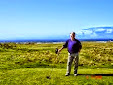
Craig, Stu and I played here early on 28 July 2010. North Ronaldsay is the most northerly and remote of the Orkney islands, is only 4 miles long and 2.5 miles wide and has a population of around 60. The climate can be really tough and with only 2 ferry connections a week in the summer, life out here looked pretty hard. North Ronaldsay is unique in having a 13 mile dry stone wall going all the way round, separating the land from the beach, with the island's own breed of sheep confined to the beach, living off seaweed and rough grazing. We'd got up at 0615 to catch the 07.35 flight to North Ronaldsay in an 8 seater plane from Kirkwall, where we'd stayed overnight. The airfield is well over a mile from the golf course but we were lucky that someone gave us a lift in a battered van that had seen better days a long time ago. I sat on the floor in the back, with some empty tins of beer, a half-empty bottle of vodka and the skulls of 3 sheep rolling around my feet. North Ronaldsay was already "different" and we'd not even seen the course yet.
The golf course is on the seaward side of the wall and is flat and fully exposed to the elements. We'd seen a video on You Tube of someone playing the course (type in "golf in North Ronaldsay") so we had a vague idea of what to expect. However, that video must be a few years old, since the course had obviously taken a battering in a succession of storms and looked to have been abandoned to its fate. Above is what is left of the clubhouse, a small wooden and concrete breeze block hut of considerable antiquity. The door had gone and sand blown into the hut over the winter was over a foot deep in places inside. Some ancient bags and clubs lay around in various stages of rust. The carcass of a long-dead rabbit or lamb lay half buried in sand in an open cupboard.  A box originally containing 12 golf balls lay open on the small table, serving as the club's "Honesty Box" for the payment of green fees (£3 according to a 1997 notice half hidden by dirt and cob webs propped up against a rotting window frame). Bizarrely, the Honesty Box contained an old £5 note and some coins, as shown here, beside a message saying that a couple of guys had played the course in 2009. The Honesty Box was wrapped in cobwebs, so had obviously lain undisturbed for a considerable time. Some old greenkeeping equipment was rusted solid, as were some old flagpoles. We also found some newish flags, bundled untidily together on a shelf, but the air smelt of decay, despite the lack of a door to this hulk of a building.
 It was less easy to identify the course itself. All we could see initially was a wasteland of flotsam debris from winter storms, sheep and their droppings, the odd animal bone (or rotting part) and some stones, strewn across flat and other pretty featureless rough grazing land, closely cropped by the sheep. On closer inspection , we came across wooden marker arrows (some still with faded hole numbers!) and stones that had obviously formed tees, and by walking out from such points, we came across old flagsticks, devoid of any fabric, lying down beside what were at one time golf holes. The hole liners were all rusted and the holes part-filled with dank water, but there clearly was a course here, albeit well hidden by neglect and decay. Thanks mainly to Craig's expert foraging ahead, we were able to piece the course together. There were no scorecards in the clubhouse and I'd not packed my laser range finder, so the yardages are approximate, but this what we played as the course, as it lay on the day -
Hole 1 - 200 yards - par 3
Hole 2 - 130 yards - par 3
Hole 3 - 110 yards - par 3
Hole 4 - 350 yards - par 4
Hole 5 - 100 yards - par 3
Hole 6 - 252 yards - par 4
Hole 7 - 230 yards - par 3
Hole 8 - 290 yards - par 4
Hole 9 - 540 yards - par 5
We therefore reckoned the course "on the day" to be 2202 yards long, with a par of 32. It may have been shorter, longer, or laid out differently, but that's what we saw and played. By the time we'd identified the 1st hole, a light drizzle had turned into steady rain, adding to the feeling of bleakness that had settled around us. We struggled to understand the attractions of living in such a remote place. As to our actual golf, it was difficult to play well in such depressing surroundings and extra care was needed on the greens, such as they were, to clear a path through the sheep droppings and other loose impediments. For the record, I parred the 5th and 6th holes in my round of 40. Here's Craig and I on the 9th green celebrating our completion of the course, with one of the flags we'd found in the clubhouse after our round. We'd played the North Ronaldsay course, or what was left of it, firing a subsequent and unresolved discussion about what properly constituted a golf course. We imagined that the islanders now had enough to do to eek out a living, mainly by crofting and tourism, and that there is little time for golf nowadays. However, as we walked back to the airfield for our 10 minute flight to nearby Papa Westray, we found it more difficult to understand how golf had started in North Ronaldsay in the first place and why it had so obviously declined in recent years. In all honesty, we suspect that only the few people keen to play as many Scottish courses as possible would venture to play a game here. A pity, since at one time there was presumably a decent 9 hole course here.
 A box originally containing 12 golf balls lay open on the small table, serving as the club's "Honesty Box" for the payment of green fees (£3 according to a 1997 notice half hidden by dirt and cob webs propped up against a rotting window frame). Bizarrely, the Honesty Box contained an old £5 note and some coins, as shown here, beside a message saying that a couple of guys had played the course in 2009. The Honesty Box was wrapped in cobwebs, so had obviously lain undisturbed for a considerable time. Some old greenkeeping equipment was rusted solid, as were some old flagpoles. We also found some newish flags, bundled untidily together on a shelf, but the air smelt of decay, despite the lack of a door to this hulk of a building.
  It was less easy to identify the course itself. All we could see initially was a wasteland of flotsam debris from winter storms, sheep and their droppings, the odd animal bone (or rotting part) and some stones, strewn across flat and other pretty featureless rough grazing land, closely cropped by the sheep. On closer inspection , we came across wooden marker arrows (some still with faded hole numbers!) and stones that had obviously formed tees, and by walking out from such points, we came across old flagsticks, devoid of any fabric, lying down beside what were at one time golf holes. The hole liners were all rusted and the holes part-filled with dank water, but there clearly was a course here, albeit well hidden by neglect and decay. Thanks mainly to Craig's expert foraging ahead, we were able to piece the course together. There were no scorecards in the clubhouse and I'd not packed my laser range finder, so the yardages are approximate, but this what we played as the course, as it lay on the day -
Hole 1 - 200 yards - par 3
Hole 2 - 130 yards - par 3
Hole 3 - 110 yards - par 3
Hole 4 - 350 yards - par 4
Hole 5 - 100 yards - par 3
Hole 6 - 252 yards - par 4
Hole 7 - 230 yards - par 3
Hole 8 - 290 yards - par 4
Hole 9 - 540 yards - par 5
We therefore reckoned the course "on the day" to be 2202 yards long, with a par of 32. It may have been shorter, longer, or laid out differently, but that's what we saw and played. By the time we'd identified the 1st hole, a light drizzle had turned into steady rain, adding to the feeling of bleakness that had settled around us. We struggled to understand the attractions of living in such a remote place.
 As to our actual golf, it was difficult to play well in such depressing surroundings and extra care was needed on the greens, such as they were, to clear a path through the sheep droppings and other loose impediments. For the record, I parred the 5th and 6th holes in my round of 40. Here's Craig and I on the 9th green celebrating our completion of the course, with one of the flags we'd found in the clubhouse after our round. We'd played the North Ronaldsay course, or what was left of it, firing a subsequent and unresolved discussion about what properly constituted a golf course. We imagined that the islanders now had enough to do to eek out a living, mainly by crofting and tourism, and that there is little time for golf nowadays. However, as we walked back to the airfield for our 10 minute flight to nearby Papa Westray, we found it more difficult to understand how golf had started in North Ronaldsay in the first place and why it had so obviously declined in recent years. In all honesty, we suspect that only the few people keen to play as many Scottish courses as possible would venture to play a game here. A pity, since at one time there was presumably a decent 9 hole course here.


 , which ran a little faster as the course gradually dried out during our round. Indeed, I came back in 40 for a gross 86, net 76 and a mid-pack finish. I suspect the back 9 is the easier half, but even so, there are some tricky holes. How about this, the "view" from the 15th tee? The green lies 330 yards away, straight through the gap in the trees. There's out of bounds and a busy road to the right, and a pond over the trees to the left. I'd hit my drive to the left and narrowly missed the pond leaving myself with an awkward lie on the side of a hill. The green is hidden by another hill and there's some houses immediately behind the green, just to make it even more difficult. I sneaked a good par here after an excellent up and down from a greenside bunker.