Saturday, 27 August 2011

Pollok GC - Course no 442

Playing here on 26 August 2011 was the fulfillment of a long-held ambition.  I'd lived a couple of miles away as a boy and my secondary school was just along the road from the course.  But the nearest I got to playing here was hanging around the car park in my early teens hoping for a caddying job and scuttling amongst the bushes and trees looking for lost balls to sell back to the members to supplement our meagre pocket money.  Many's the time we were chased off, but we meant well and our trespassing was harmless enough in reality.  I also have a vague memory of dodging school in the early 1960s to watch a professional tournament played here by the likes of Harry Bannerman, John Panton and Eric Brown, all famous in their day as top Scottish professionals.  Since then, I'd seen Pollok as a top course, not the place where a local kid brought up in a nearby council housing estate would necessarily get to play, even in his adult years.  So, I was really looking forward to playing here and I'd entered the club's Senior Open, as played on 26 August 2011.

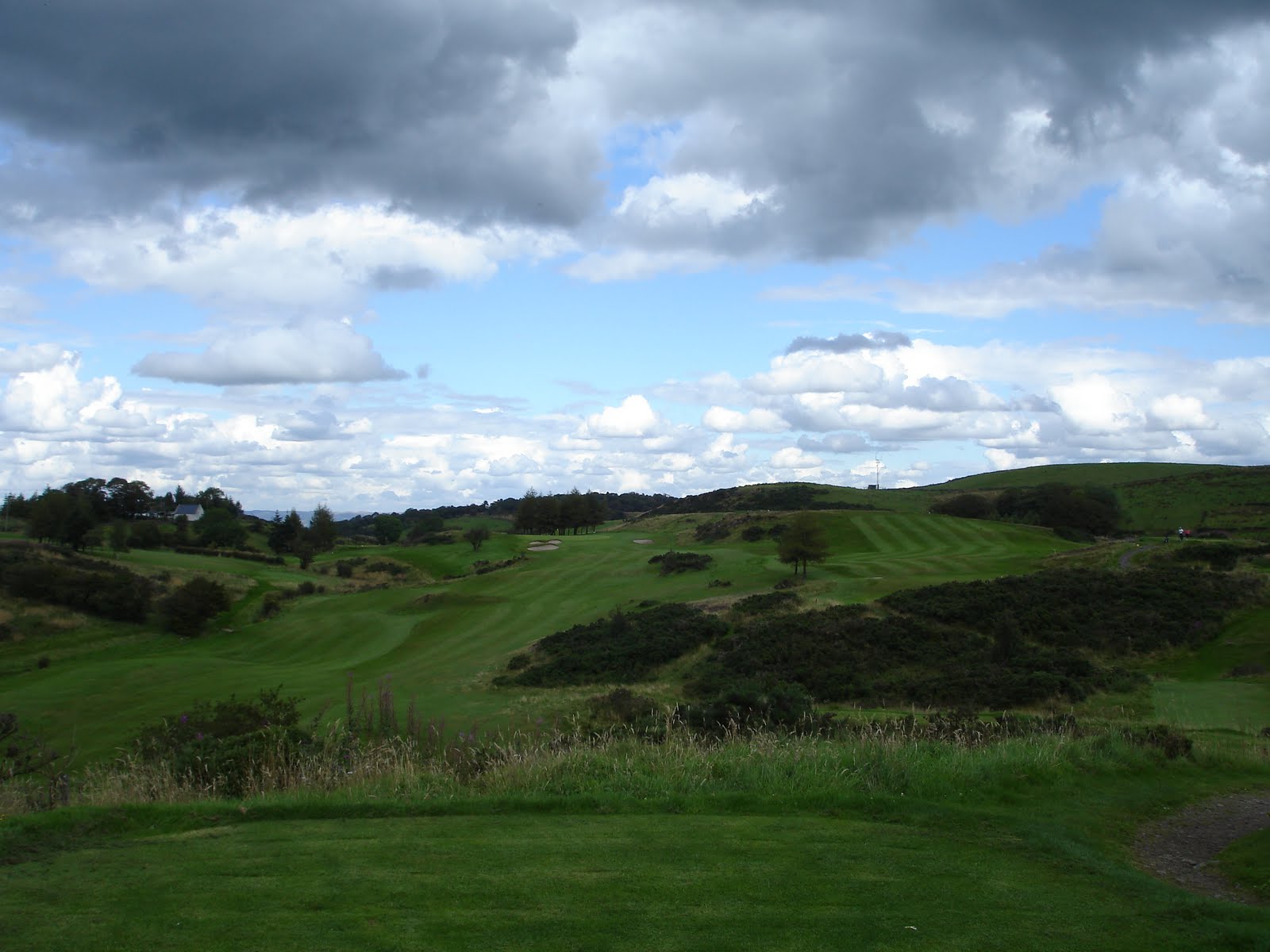
Pollok exceeded even my high  expectations.  The members were tremendously welcoming and friendly, the competition was one of the best-organised of the many opens I've played in over the years and the course itself was simply outstanding and in great condition.  Pollok is a parkland course measuring 6043 yards, Par 71 off the yellow tees (well, it was a seniors event). The course was refreshingly flat and easy walking after my many successive days of golf and caddying and only the occasional background traffic noise reminded me that the course is only a few minuted drive from the centre of Glasgow.  The course is laid out amongst deciduous woodland (mainly ash, beech,  oak, elm and chestnut trees) of the former Pollok Estate, also now home to the world famous Burrell Collection, now housed in the impressive Pollok House.  Few courses have such an impressive setting and I hope that this view from the 15th green over to Pollok House gives a flavour of this.   

I'd also been lucky to play with a couple of great guys from nearby courses and we all thoroughly enjoyed ourselves.   Thanks again,Tommy and Brian!  I'd started nervously with a 50 yard duck hook into heavy rough, so a double bogey opener didn't auger well for my chances.  However, I steadied from there and such was the lushness of the fairways I could even play some long irons pretty well.  However, trouble on the 7th and 9th meant I was out in 45.  I'd been 40 yards short in 2 from the green at the 420 yard par 4 9th, the Stroke Index 1 Hole with a decent lie in light rough, only to sh---  the ball into rough around a foot tall, another 40 yards to the right of the green.  How I got a lob wedge to within 5 feet from there I'll never know, but it was more luck rather than skill.  If I'd been that good, I'd not have been there in the first place!  Sadly, I missed the short putt, but that was certainly my shot of the day.   

The back 9 at Pollok was even better than the front, with a succession of great holes, my favourite being the 366 yard 14th, a Par 4 dog leg left requiring a long tee shot over a bend in the White Cart River that runs alongside that part of the course.  I'd hit my best drive of the day, followed by a low 4 iron to the heart of the green, only just missing my birdie putt on the Stroke Index 2 hole.  I bogeyed the 15th after finding a greenside bunker, but I finished strongly, parring each of the last 3 holes.  I really don't like being anywhere out in the open when there's thunder and lightning around, so when the first roll of distant thunder started as we teed off from the 16th, I was expecting to hear the klaxon suspending play.  It had been a hot and humid afternoon, just right for lightning, so when the air got even heavier and the skies darkened we knew trouble was approaching. 

This is the 18th, an uphill 382 yard Par 4 with some menacing clouds overhead.  The temperature dropped just as we finished the hole, the skies darkened further to the point that the external lights on the clubhouse came on and the skies opened.  I sheltered by the clubhouse door for a few minutes, but with the torrential rain showing no signs of abating, some unlucky golfers scurrying for shelter from the storm and the car park rapidly turning into a quagmire, I decided to return to the car.  I was soaked by the time I got there, despite risking using my umbrella, only to find I'd forgotten to hand in my scorecard.  So, back up the path to the clubhouse I went, only to find that by then the course had flooded and the competition would in due course be void.  I'd gone round Pollok in 88, net 78 with 34 putts.  Not the score I'd been hoping for, but I'd had 9 pars.  It's just a pity that the other holes were so bad.  Still, I've now got some idea how to play the course and I'd love to play here again, so I'll be entering next year's Senior Open. 

This is an outstanding course.  A "must play" if you're ever in the area.

Thursday, 25 August 2011

Beith GC - Course no 441

Graeme and I here on 25 August 2011 after our game at Mearns Castle.  This is  a formidably hilly 18 hole parkland course set in rolling hills high above the village of Beith in upland Ayrshire.  It's not long at 5456 yards, Par 69 off the Yellow tees, but it's still a stiff test.  As the club's website says "If you like a challenge, you will not be disappointed as we have a course that will test all abilities. Beith is a hilly parkland course with spectacular views over the surrounding areas, from Ailsa Craig & Arran to Ben Lomond. Converted to 18 holes in 1996 with the addition of nine new holes, the rolling fairways, small undulating greens, along with the prevalent strong winds ensure the course is a tough, but fair test for golfers of all levels." 

Being so high up, it's certainly exposed to the elements, as we were to find out soon after our round when a storm blew in, producing torrential rain (no doubt soaking the 3-ball that waived us through here on the 2nd.  When we passed them again on our way to the 17th, they were just leaving the 11th tee!)   These guys also let others play through, so fair play to them for that, but slow play can sometimes reap its own rewards.  The 2nd is a typical Beith hole, requiring a long drive to carry a stream and a long uphill shot (and climb!) to a large sloping double green shared with the 7th.  We'd both parred the 1st, a 289 yard Par 4 played steeply downhill short of a stream, then steeply uphill to a small plateau green.  The 1st flag had been yellow, so we both played to the yellow flag on the 2nd, ignoring the red flag, much nearer to the 2nd fairway.  That was a poor decision, as on closer inspection the red flag had a "2" on it! 

Beith had our full attention by then and we were also marvelling at the great condition of the course, despite its exposure to everything that the west of Scotland's weather can throw at it - which is very considerable!  The fairways were manicured and well cut and the greens were fast-running, true and even, with some subtle slopes to make putting a real test.  The 333 yard Par 4 3rd was played downhill initially to a narrow fairway edged by trees and gorse, but finding the fairway was the easy bit.  From there we faced an improbably steep hill and a marker pole, but in my tired state there's no way I was running forward to see what lay beyond the marker pole.  I'd somehow found the green with my 7 iron second shot just beyond another improbably steep downslope and won the hole with a bogey.  Next was a blind drive over a marker pole at the top of another hill.  another bogey there, but at least I'd not lost a ball, yet.  This is the 6th, a great 377 yard Par 4, played from an elevated tee.  We'd both hit good drives, only to see our balls run away down the neighbouring 8th fairway, away from our intended direction of travel.  From there, I'd a blind second shot and hit a decent 7 iron towards the green.  No doubt someone will find it some day (a Titleist with a single black dot below the number 4!) but that cost me a double bogey, quickly followed by another on the 7th.  I'd gone out in 43, spent most of my remaining energy climbing up and down every hill within sight of the front 9 and was loving every minute of it.  I suspect that you'd either love it or hate it.  I'd visited it a few months back, took one look from the car park and decided against playing it (as it would then have been my third course of that particular day).  So, as I'm not normally a great fan of hilly courses, I'd expected not to like this course.

The 10th Hole at Beith is possibly the most tiring I've played recently, and that's saying something after my endurance test over the Murrayshall course a few days earlier and on my recent Iona trip.  The 11th is only 345 yards and the drive is played from an elevated tee over the same stream that features on the 2nd and can be seen on the above photo from the 2nd tee.  I'd hit a good drive, but then faced yet another climb, with my 9 iron having to be played blind over a wall and some trees, past a cairn marking the site of the first clubhouse.  There's now no sign of that old building or how it was reached from the village and a seat would have been my choice of memorial to it!

The back 9 is more open and looked like they were the holes added in 1996 to make Beith an 18 hole course.  Best hole on the back 9 was probably the last, a largely uphill 411 yard Par 4.  This is Graeme striding up the last fairway i.e. I'm lagging some way behind!  I was delighted to get a par at this hole and to go round Beith in 85, net 75, some 6 strokes adrift from the course par.  I'd hit the ball reasonably well and really enjoyed the course.  We just had time to get the car packed and head off for home before the skies opened, so good timing and a really good course in great condition. 

My one reservation about Beith was the scorecard, a hideously offputting jumble of numbers and colours, complete with markedly differing match play and stroke play Stroke Indexes.  Indeed, I can't remember ever seeing another scorecard showing stroke play Stroke Indexes.  Does anyone have any ideas what that's about?

Mearns Castle Golf Academy - Course no 440

I played here on 25 August 2011 with Graeme, an old friend of mine at the Glen GC. We were on our way to play at Beith GC and we stopped off here to play the 9 hole parkland course attached to the impressive Mearns Castle Golf Academy, to the South West of Glasgow.  I've come across some pretty unremarkable driving ranges and practice facilities in my own travels around Scotland, but this is definitely one of the very best I've seen, with coaching led by some former European Tour professionals who have also become leading coaches in their own right.  Throw in a children's nursery (a great idea!) and an excellent 2542 yard Par 33 parkland course and this centre really stands above the rest.  We'd expected that on a midweek morning the place would be pretty quiet.  Not so, but thanks to the very welcoming and  helpful staff there, we squeezed onto the course (and I really liked the odd name for the local business that sponsors the Ist hole!)

The scorecard even had a helpful map of the course, but did we study it in advance?  Did we know there was a stream across the fairway at the 1st, ready to drown anything overhit from the tee?  Of course not, as that would have been good course mangement.  Instead, we footered our way around, wary of the hills we'd be facing later in the day at Beith.  Indeed, I was still tired after so many successive days of golfing and caddying etc. and by the time I'd negotiated  the modest hill on the 2nd Hole here, I was reminded I'd forgotten to bring my lighter golf bag and leave half of my clubs in the car!  I'd taken a double bogey at the 1st, so a par at the 2nd, a largely uphill 495 yard Par 5, and the Stroke Index 1 hole, was pretty satisfying.  However, another double bogey at this, the 394 yard 3rd Hole, was disappointing.

We both liked the 4 Par 3's here, ranging from 141 to 191 yards, with the uphill 8th, at 191 yards, being a really good test.  I'd gone round in 40, net 35,  (so 2 over the course par) with a disappointing 17 putts.  We both really liked the facilities at Mearns Castle Golf Academy and envied those who had it on their doorstep.


Monifieth Golf Links - Ashludie Course - Course no 439

Polly and I played here on 23 August 2011 after our differing exploits over the Murrayshall course the previous day.  Unlike Murrayshall, the Monifieth Golf Links are flat and as the names suggests, built on sandy linksland.  There are two courses here, the Championship course itself, which is used as a final qualifying course when The Open Championship is played at nearby Carnoustie and the shorter Ashludie Course.  Although the Ashludie is only 5123 yards, Par 68 and when we played it was used mainly by senior gents and ladies, don't go thinking that it is easy.  The fairways are narrow and bordered by heather and gorse and the greens were probably the fastest I'd seen all year.  Just to make it even trickier, some of the fairways were cambered and higher than the surrounding rough, meaning that anything hit even slightly offline might bounce off into the rough or worse still, impenetrable gorse bushes.  I was hitting the ball pretty straight off the tee, but my ball would sometimes take an awkward bounce, land short or run through the green.  Welcome to links golf.  Precision was called for on every shot, making Ashludie a hugely enjoyable test. 

The toughest hole on the course is Hole 7, a 445 yard par 4 and deservely the Stroke Index 1 hole.  I'd hit a good long drive, but the fairway then becomes a plateau, some 5 or so feet higher than the surrounding rough, calling for a lazer straight second shot.  Now unlikely as it will seem to all who have seen me play recently, this is my ball, just short of the green after just such a shot, played with a long iron, would you believe.  A bogey from there was slightly disappointing, but I'd take it every time, given the disaster potential here. The Ashludie Starter's hut is in the distance behind the green, a healthy walk from the car park, past the 4 (or was it 5?) separate club houses of the various clubs that play over the Monifeith Links.

I'd managed to miss the heavy rough for the first 7 holes, but just as I was congratulating myself on negotiating the 7th, a hooked drive off the 8th tee into the long stuff, then heather, led to an ugly treble bogey.  I'd slumped to 41 at the turn after a decent start to the round.  If anything, the back 9 was even tighter.  I'd parred the 13th, a 259 yard Par 4, after hitting my 3 wood shot past the green to within a few yards of the OOB and someone's back garden.  This was Ashludie after all of the recent rain, so goodness knows how fast this tight course gets in dry, windy conditions! This is the 14th, a short 252 yard Par 4.  Anything right from the tee risks being lost and a ball hit left is only marginally safer.  I'd gone long and left, close to the previous hole's tee, but was still faced with a mound in front of the flag, making it tricky to hold the green with my lob wedge approach, leading to another bogey. 

Ashludie was great fun and very easy walking after my slog around Murrayshall.  I'd gone round in 82, net 72, with 30 putts.  I'd also managed not to lose a ball, a feat in itself.   I was due to play a semi-final foursomes tie over my own course the next day (which we won!) and this lovely little links course was excellent preparation.  Ashludie may be the lesser of the two courses at Monifieth, but it's still well worth playing.  Just don't take it too seriously and enjoy yourself.  If you have the time, practice your long putting on the practice green behind the Ashludie Starter's hut.  When did you last go for a 100+ yarder and be happy with a 3-putt?

Tuesday, 23 August 2011

Murrayshall Golf Course

Polly's former employers had laid on an excellent golf day and dinner on 22 August 2011 at Murrayshall Hotel near Perth to mark her recent retirement and had very kindly invited me to join in the celebrations.  This 4-star hotel has two 18 hole golf courses, Murrayshall and the newer Lyndoch.  Both are parkland in nature and we'd both played them before.  However, we'd only played the older Murrayshall course in a foursomes format, so this was an opportunity for me to see how I'd fare on my own off the gents tees.  The Lyndoch course is extremely hilly and not a favourite for that reason, but although I'd remembered that the Murrayshall course also had some hills, it was something of an unwelcome surprise to find that it was far more hilly and physically demanding than I'd expected.  Perhaps it was just that the course was playing long after recent rain, or that I was playing a hilly course after either playing, marshalling at the Scottish Ladies Open at Archerfield or caddying every day for the past couple of weeks.  Whatever the cause, I really struggled to get round the Murrayshall course and needed that beer afterwards.    

The course measures 5868 yards, Par 71 off the yellow tees, but was playing really long, with little run on the fairways and with my low energy level, all of the seemingly many holes played uphill were nothing short of a slog.  My gross 92 was disappointing and I did little to contribute to my team's total Stableford score, so it was not surprising that David, Stuart and I lost out to Polly's team.

Polly and I had sponsored this, the 4th hole, a tricky 135 yard slightly downhill Par 3, played over a large pond.  I was nearest the pin in my group after an easy 8 iron to 20 feet, but Polly won the bragging rights after hitting her ball to nearest the pin overall.  She was somewhat embarrassed to win the sponsor's prize, so it was agreed that we'd carry that prize over to a charity golf day that Craig, Stu and I were organising (with Polly's help again) to be played at Monksford House on 28 August (which subsequently raised over £800 for the Cancer Research UK charity).

I also liked, this, the 10th, an awkward 283 yard Par 4.  Play a driver here at your peril.  I'd done that, but the fairway falls away to the right and I finished blocked out by the big tree on the right.  I'd really no shot as the plateau green is fronted by a large pond, but if I could aim at the bushes to the left and produce a sharp slice, I might just make the green. Now I can usually slice to order, but my heroic effort quickly drowned in the pond, leaving me scrambling for a double bogey.  Another word of warning.  The dogleg on the 12th cannot be carried by an easily swung 7 wood.  I'd tried that, but there's a hidden gully (and the recent rain had turned it into a swamp, hence the need for my white trousers to be washed on our return to sunny East Lothian!) 

This is Polly hitting her ball close on the 18th, watched by her playing partners, Roddy and Ramsay.  She's already organising another match over our own course at The Glen GC (see www.glengolfclub.co.uk).  It has fewer hills and almost no trees, fast running fairways and greens and fewer water hazards, so is more to my liking.  Murrayshall is a good test and there are great views from both of the hotel's courses, but there are just too many trees and hills for my personal taste. 


Monday, 15 August 2011

Craignure GC - Course no 438

I'd stayed on Mull overnight after playing on Iona and I had time to play the Craignure course on the morning of 13 August 2011 before getting the lunchtime ferry back to Oban.  However, the heavy rain had continued overnight and was still coming down in buckets when I arrived.  The course looked to be pretty sodden and being low lying and built on marshy looking peat-based ground, I was clearly going to get very wet, again.  The Craignure course has 9 greens and 18 tees, making it an 18 hole golf course.  I played the course with a ball from each tee, in effect playing holes 1 and 10 etc at the same time, to make sure I got round in time for the ferry and at least avoid some of the rain.  That plan worked OK, thanks to some really outstanding course signage.  As I've mentioned before in previous blog reports, some courses don't think about visitors and seem to assume that they will be able to navigate their way around their courses without difficulty.  Not here at Craignure.  The signage is amongst the best I have seen, so well done to the small band of volunteers that keep this little village course going.  They must be a trusting lot too, since although the clubhouse door was locked, they'd left the windows open!

The course turned out to be even wetter than I'd imagined, with water frequently splashing over my shoes.  This is a view from the 6th tee, but to get there the water on the path through the bracken was ankle deep.  On some fairways and paths I was literally walking through water 4-6 inches deep in places, so I was really surprised that all of the greens were still perfectly playable.  On the downside there was no run at all on the fairways and most shots were either plugged or in casual water.  Despite all of that and the continuing deluge I played relatively well, aided by some good putting.

This is the view from the 8th tee, with the 7th/16th green in the foreground and the 17th beyond that.  The driver of the silver car (a Mercedes!) in the middle of the photo decided it would be a good idea to watch me playing the hole and parked right behind the green, only a few feet away and right on my line.  My cautious 6 iron off the 8th tee (177 yards in the pouring rain!) cost me a shot, but I'd rather that than hit the car.  I finished the Craignure course in around 90 minutes, taking 84 overall, net 74, against the course par of 67, with 30 putts.  Craignure is short at 5227 yards, but plays much longer in the rain!  Good fun and great signage, but with 18 holes in such a small area  I suspect that it's best played when there are few others about.  Indeed, to play the 9th/18th holes, you almost have to drive over anyone playing the 7th/16th and 8th/17th holes.

If you ever get to make the trip to Iona, and I recommend you do, try adding Craignure to your itinerary and hope it doesn't rain. 

Iona Golf Course - Course no 437

Iona is a small island, barely 3 miles long, to the west of the island of Mull and as such is pretty remote.  Iona is world famous for its ancient Abbey and attracts thousands of tourists a year, either to visit the Abbey, walk its sandy shores and rugged hills or study its wild life etc.  However, few appear to know that there's an 18 hole golf course on the west side of the island and that the highlight of the golfing year on the island is the annual playing of the Iona Open, organised by the Honourable Company of Iona Golfers.  I'd heard about this tournament from internet research and after some investigation was put in touch with George Hillard III, an American academic who had been coming across to play this old course for many years and was clearly a devotee of the course, the HCIG and the island itself.  Indeed, it seemed that this annual competition attracted amateur golfers from all over the world, as much for the general camaraderie and apres-golf as for the game itself.  Accordingly, Craig, Stu and I were keen to play in the 2011 Iona Open and Bert and Jim, their fathers, were roped in to join in the adventure.  Unfortunately, work and other pressures meant that only I could make the trip to play in the Iona Open on 12 August 2011. 

To set the scene, we'd all stayed in a no-star hotel in the back streets of Oban and after a late night celebrating our games at Dragon's Tooth etc. it was with some difficulty that we mustered for breakfast at 06.30.  I suspect that there might have been a choice, but the formidable waitress's advice that "you will have full Scottish breakfast, yes" appeared to be more of a command than a question.  We weren't minded to argue and with a long day in prospect, I risked the cholesterol one more time, taking another hit for the team.  We'd been dodging the rain the previous day, but the local weather forecast was grim, with heavy rain coming in from the West on an Atlantic depression.  Iona is roughly west of Oban, with the Iona course facing the Atlantic, so at least I was safe from getting sunburnt.

The ferry from Oban lands on the east side of Mull and its a 35 mile drive from there to the west side of the island to get the ferry to Iona, on an often bumpy single track road with passing places.  That drive is simply stunning, through forests and mountains, and past various sea lochs, so there was a real sense of expectation by the time I got to Iona.  It's a 45 minute walk to the course along yet another single track road, but I'd missed the ferry I'd planned to take and was going to miss my tee off time as a result.  I needn't have worried, as some other golfers stopped to give me a lift.  This is me on the 1st tee, with George and Bibby, my playing partners and the lady starter, who's quiet board had "quiet please" on one side to help the serious golfers and "keep talking and don't watch" on the other, for the less serious competitors.  Clearly we were in the latter category, but with the weather forecast already looking ominously accurate, we would not be letting the rain dampen our spirits.  This would be a fun round.

The Iona course (4491 yards, Par 66) dates back to 1886 and was laid out on an area of rough grazing land set between some substantial rocky outcrops, reminding me in parts of the Barra, Solles and Whalsay courses.  The sheep and cattle had been cleared off the course and 18 greens had been cut and tee markers laid out but otherwise the Iona course was completely natural, with the sheep and cattle keeping the course cut and extremely well fertilised.  Preferred lies were in play, but given the amount of manure in situ, extreme care was necessary on some holes.  This was a throwback to how I imagine golf began, on land that was a far cry from the manicured surfaces we all normally play on.  Another curious feature at Iona was the depth of the holes and the flags themselves.  George told me that various experiments had been made over the years to maintain holes that were at risk of damage from sheep etc the latest one being to make the holes over a foot deep and lined with piping.  The sheep also ate any flags that had been blown over, so the individual flags were made out of old lurid pink plastic fishing floats.  This was not Augusta and as the skies opened, it wasn't looking much like August either. This is the 3rd green.  Normally you'd be able to see far out to the Atlantic, but the fuzziness of this photo is actually rain!
The Iona Open is played over an 18 hole course, but the competition itself runs over the first 11 holes, with the HCIG Match Committee discarding your worst 2  scores.  National handicaps don't count, and the best scratch scores for 9 holes win.  George was a past HCIG Captain and it was a real pleasure to meet Spencer Patrick, the current Captain and several other regular competitors on the way round.  This is George negotiating his way up the 2nd fairway.  Note the rocks.  Hit these and be prepared to duck or gain/lose several yards!

My opening drive on the 320 yard 1st Hole was a classic 30 yard duck hook, but I did at least recover from that to get to the green in 4 blows.  The greens at Iona are simply areas of rough grazing covered liberally in weeds, flowers and manure, cut marginally shorter than the rest of the land.  You can't really make a normal putting stroke and even the shortest putt can bounce offline (and you simply can't remove every scrap of sheep dropping!) so single putts are rare unless you've missed the green and chipped to within a few inches.  Downhill putts are a particular problem so how I finished the 1st with a bogey 5 I really don't know.  I also bogeyed the 2nd, but there were encouraging signs that I might actually go on to hit the ball reasonably well.  The 3rd is a hugely difficult and spectacular uphill Par 3 of 190 yards, dominated by a huge natural bunker (roughly 40 yards by 30 and several feet deep) that from the number of deep footprints etc. looked as though it might be used as a shelter by sheep in storms.  Not the place to get into, far less get out of!  There's also rocky outcrops behind the green that must be avoided.  My 7 wood wouldn't reach the green and would be likely to put me into the bunker, so a choked down driver was the only option.  That was OK, but landed on the wrong side of a 4 foot high livestock fence, so a 5 from there was a bit of a setback. 

However, I settled down to some decent play after that hole, and actually parred 4 out of the next 5 holes.  The Iona Open ends on this, the 11th, a hugely tricky 185 yard Par 3.  The tee shot is completely blind, over the side of a hill.  Anything left risks hitting one of the 50 foot high rocky outcrops that protect the small green, set in a hollow.  Anything right might either hit another outcrop or go over a cliff and be lost.  I'd hit my trusty 7 wood yet again and was lucky to stumble across my ball in heavy rough just short of the cliff, so I was happy enough to escape with a bogey 4 from there.  I'd scored 39 for my best 9 holes over the Open course and really enjoyed the company of George and Bibby, both of whom hit some good shots.  shot of the day went to George, for a miraculous second shot on the 11th from all of 100 yards to within inches of the hole for his closing par.  I doubt whether 39 would be good enough for a prize, but I'd really enjoyed my first encounter with the Iona Open.
Although the competition had ended, I still had to complete the round.  Only 7 holes, but since George had been so efficient in guiding Bibby and I around, I'd not realised just how tricky it would be to navigate those remaining holes successfully.  To make matters worse, the rain became pretty bad from 11 onwards, rendering my gloves completely useless.  It became a case of hitting the ball forward and walking on from where it landed to find a green and hope that you'd found the right one.  That worked OK until the 15th, where I hit in completely the wrong direction, towards the 8th tee.  This is where I also got a reminder that the Iona Open attracted golfers from all over the world.  I'd asked some guys on the 8th tee for directions to the 15th.  The answer came back in German to the effect that it was behind me, a long long way!  I allowed myself the luxury of re-starting that hole and finally bogeyed it with my 5th successive single putt (after missing greens and chipping close).  My final score round Iona was 83, net 73, or 7 over the course par of 66, with 27 putts.  This is a final view of the course, the 18th green (and my by now very wet golf bag). 

Bibby, George and most of the other competitors had long since left for shelter in the local pub, so I had a long walk back to the ferry slipway.  I was thoroughly soaked by then, so thank you again to the local couple who gave me a lift for the last half mile.  Thanks too to all of the people I met and who made me so welcome.  The Iona golf course is a long way away, but there's something special about the place, a raw beauty in the landscape and a warm welcome for all golfers.  The Iona Open is played every August and I hope I can get over there again sometime.  It surely can't be that wet again.

I stopped for a while driving back on Mull to take this photo as a further memory of a perfect golfing day, despite the soaking I'd taken.