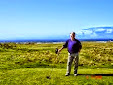
As with many other clubs in Scotland a broader decline in membership over recent years created significant financial difficulties for Lothianburn, and that, together with rising debts, culminated in the club's decision earlier this year that it couldn't continue trading. The club owned its clubhouse but rented the course land from a local landowner, who also owns and operates the successful New Swanston GC, immediately adjacent to Lothianburn, on the south side of Edinburgh. Lothianburn GC has now ceased trading and its clubhouse is closed, but the landowner is effectively keeping the course open until the end of this year. What will happen thereafter remains to be seen. I gather from friends who had retained their Lothianburn memberships that at least part of the course may be added to the already impressive revised layout at new Swanston, complementing the excellent facilities now available there. The James Braid courses are an important part of Scotland's golfing heritage, so I hope that at least some of the existing holes can be saved.
The current course is a modest 5432 Yards, Par 71 off the Yellow Tees (Standard Scratch Score 68). Like its neighbouring courses at New Swanston and Torphin Hill, Lothianburn GC is laid out on the slopes of the Pentland Hills and is a mixture of parkland and moorland. Before Swanston was redeveloped a few years ago to replace some of its higher holes with some flatter ones on former farmland, Lothianburn was widely regarded as the best of those 3 hillside courses and was always known for its excellent greens.
David, Polly and I wanted to play our old course together for a final time, so we made the short trip from North Berwick on 29 September 2013 with heavy hearts. Green fees are now payable at New Swanston GC, with Lothianburn being played from the 4th Tee, the closest to the New Swanston clubhouse. I'd played Lothianburn literally thousands of times as a member but never from the 4th. My best score off the Yellow Tees had been a gross 70, net 58 in 1995 and the course layout and yardage had changed slightly since then, but I was curious to see how my current game would stand up to Lothianburn's test, as were David and Polly. I might have another opportunity to play the Lothianburn course before it finally closes on 31 December 2013, but if not, this is an account of my final round, written as much for my own memories as anything else.
James Braid was known for his use of dog leg holes in his designs and the 4th is a good example. This is a 407 Yard Par 4 running parallel to the slope (as indeed do holes 1-8). The prevailing wind is from the west, and this hole runs from west to east, but the wind was easterly on 29 September, so the 4th was playing long. I'd hit a decent drive and a good 3 Wood but was still a few yards short of the green. Missing the green to the left would invariably lead to a big score, but I'd hit a good chip to within 4 feet. However, although the greens had been cut the day before, the 4th was a bit hairy and bumpy. Still, a bogey 5 was considerably better than some of my efforts on that difficult hole.


Below is the 5th, another slight dog-leg, played blind off the tee and almost blind again for the approach to the green. This Par 4 is only 295 Yards and when the wind is from the west the bold shot is to fly the heavy gorse to the right of the fairway, hoping the ball will run down a slope towards the green. On other occasions, a decent drive over the marker pole would leave this limited view of the green and a shot that plays longer than it looks.
It can be very windy around the Pentland Hills and as this photo suggests, the 5th green can be a small target, with perils aplenty around it. I'd hit a good drive, but my 9 iron was slightly left of ideal and I over-hit a short pitch. Another bogey 5.
The 6th is a flat 135 Yard Par 3. Club selection can vary wildly dependent on the wind direction. Four bunkers front and left come into play and steep down slopes to the right and beyond make finding the green with your tee shot vitally important. I'd gone slightly left into one of the bunkers, but a good recovery to a yard set up an easy first par.
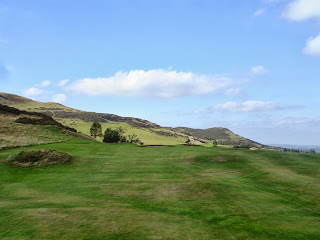
 Next the 7th, a rollercoaster 460 Yard Par 5 and the Stroke Index 1 hole, usually played into the prevailing wind. This is a lovely hole, played towards the T Wood, played downhill from an elevated and wind-exposed tee avoiding the most magnetic bunker on the course, then blind uphill towards a narrow green well-protected by 3 bunkers. The bigger hitters can sometimes reach in 2 but this was always a 3-shotter for me and occasionally considerably more! I'd hit my drive too far left into the first cut of rough. From there, it was a 27 Degree Rescue and a 9 iron to the heart of the green. 2 putts later and I'd parred the S.I. 1 hole (and by this time David was a remarkable 3 under par!)
The 8th is a 355 Yard Par 4, wind against when we played it. The green is just visible from the tee, but the tee shot must be hit left of that, over a large hill. The second shot, as shown here, can be anything from a wedge to a 5 iron. Right of the green leaves a bogey or worse on the cards. I was just short in 2 with my 27 Degree Rescue, but another easy par.

The 9th is Lothianburn's heart attack hill, a sometimes fearsome uphill 324 Yard Par 4, that can be Driver, 3 Wood and a short iron on a windy day. Right of the fairway is dead and the green itself can be lightning quick. Indeed, one August Medal competition that I played in had to be abandoned after the green became unplayable in a hot and strong wind. It was an otherwise perfect summer's day, but this green slopes steeply from back to front and the pin position was such that unless a putt was holed, chances were it would roll down the steep slope in front of the green. If memory serves, I had a 9 after first reaching the green in 3. Yesterday, I was again on in 3 but single-putted from a yard for another par. I was sometimes relieved to even bogey this difficult hole.


 The 10th as shown here is the shortest hole on the course at only 106 Yards and is usually little more than a flick with a wedge, on a calm day. However, the wind tends to swirl around this part of the course, thanks to the T Wood nearby and 6 deep bunkers that surround the green must be avoided. I played an easy 9 iron to the back of the green and had an equally easy par, but I've lots of scar tissue from this hole and memories of far higher scores. Sh--- here at your peril. From there, it's a short walk through the T Wood to the 11th and 12th Holes, another great section of the course.
This is the 11th, a 267 Yard Par 4 that's almost defenceless on a calm day. The ideal line is the left side of the green and anything past the small bunker around 220 Yards out leaves just a short pitch to an uphill green. However, on a windy day OOB to the left comes into play, as does a steep downslope to the right of the fairway. The green itself is long and narrow and breaks more than you might think. I'd hit a good drive beyond the bunker and had only a lob wedge to the green. 2 putts for another par.
The 10th as shown here is the shortest hole on the course at only 106 Yards and is usually little more than a flick with a wedge, on a calm day. However, the wind tends to swirl around this part of the course, thanks to the T Wood nearby and 6 deep bunkers that surround the green must be avoided. I played an easy 9 iron to the back of the green and had an equally easy par, but I've lots of scar tissue from this hole and memories of far higher scores. Sh--- here at your peril. From there, it's a short walk through the T Wood to the 11th and 12th Holes, another great section of the course.
This is the 11th, a 267 Yard Par 4 that's almost defenceless on a calm day. The ideal line is the left side of the green and anything past the small bunker around 220 Yards out leaves just a short pitch to an uphill green. However, on a windy day OOB to the left comes into play, as does a steep downslope to the right of the fairway. The green itself is long and narrow and breaks more than you might think. I'd hit a good drive beyond the bunker and had only a lob wedge to the green. 2 putts for another par.
The 12th is another good short Par 4 at 293 Yards. The ideal line is usually left of centre to set up a short wedge played blind uphill to the green. OOB lurks immediately behind so accuracy is essential. This is David bombing another drive off the tee. I played the hole perfectly and made the 8 foot birdie putt.
The 13th is yet another short Par 4, this time 228 yards uphill with OOB to the right of the fairway and behind the green. It's usually possible to drive the green, but I went too far left, leaving a very short lob wedge steeply uphill. I found a small gully at the back of the green and rather than take the putter, I foolishly attempted a chip out of a fluffy lie. My fluffed chip led to a bogey on one of the easiest holes on the course. I remember making an eagle 2 here many years ago in a 3-club competition with a couple of well-hit 5 irons. Yes, me hitting successive well hit shots with an iron, but it's true.

 The 558 Yard Par 5 14th is perhaps the most memorable hole at Lothianburn, a steeply downhill hole with OOB on both sides. There was usually time to admire the view before trying to find the fairway with your drive. Until recently, an OOB line ran all the way between the 9th and 14th, affecting only play on the 14th. However, that line now starts well down the 14th, making the tee shot far easier than "in our day." I much prefer the earlier tougher version, which contributed to the 14th being Stroke Index 2. I hit a great drive down the left side of the fairway, (well past the "plateau", for those who know the course) followed by an easy 8 iron downhill and another one steeply uphill to the small green. A couple of putts for another par. I was 2 over par after 11 holes, so not bad....
The 303 Yard 15th is the easiest Par 4 on the course. Played with the prevailing downwind from the west, this hole is easily drivable. You simply go as left as you dare towards whin bushes and hope your ball carries over the crest of a steeply side-sloping hill and rolls all the way down to the green. With the wind coming directly into our faces it was more of a test and a weak pitch and run left me with a 30 foot putt which was slower than I'd expected. Still, a bogey 5 was poor on such an easy hole. (Polly tells me the 15th had previously been a steeply downhill Par 4 but is now a long Par 3, as is the 18th, tightening the Ladies Scorecard).
From the easiest to the most awkward. The 16th is a slightly downhill 306 Yard Par 4, with gorse on both sides of the fairway. The fairway also slopes from the centre down to the right towards gorse bushes, so only a very straight drive will do. This is Polly and David on their way to the green. The fairway looks wide enough, but I've come to grief many a time on this hole!
I'd hit the perfect drive and had 89 Yards to the pin into the strengthening easterly wind. An easy wedge to 10 feet and a straight single putt gave me another birdie. Back to 2 over par.
The 17th is an uphill 307 Yard Par 4 with a narrow fairway and trouble looming either side. Only a long and straight drive will do and with the wind behind that was done, setting up an easy lob wedge to the green. I hit that a bit too hard and was in light rough at the back of the green. A bogey from there was disappointing, though.

The downhill Par 4 18th is 281 Yards from the elevated Yellow Tee and again, straight is your only option, since gorse awaits anything remotely offline, particularly to the right. This fairway tends to dry out and get very hard and fast, adding to the difficulty, as the photo below shows. The green is easily drivable with a westerly wind, but I was still 20 yards short. A good pitch and run to 6 feet set up my 3rd birdie. I was round the "proper" Back 9 in level par 36.


Of all the holes at Lothianburn, the 1st is my least favourite. A 236 Yard Par 4 should not be difficult, but this one most definitely is. The wind is usually coming at you from the green or from your front left, bringing OOB and gorse into play to the right. Rocky outcrops on the left of the fairway tempt you either to go far left to leave a long pitch to the green or to go for the narrow band of fairway between the rocks and gorse. Find that narrow band and it's just a short pitch to a small shelved green protected by bunkers and more gorse. A path to the right of the hole is popular with hillwalkers, so we had to wait a while and I just lost my concentration. The gorse bushes to the right of the fairway had plagued my golf at Lothianburn over the years, so it was no great surprise to see my drive finish there. I did well to make a single putt with my second ball for a double bogey 6.

The 2nd is the most difficult Par 3 and although only 144 Yards plays longer than you'd expect. The hole is slightly uphill played to a narrow shelved green cut into the side of the hill, played over an old quarry. During Centenary celebrations in 1993, the club had a series of novelty events, one being a Bloodsome Scramble, with 4-person teams made up from Junior, Senior, Gents and Lady Members. This competition worked along the usual Texas Scramble lines except that teams were obliged to play their worst shot each time, rather than their best or most favourable. The competition was eventually abandoned after one particular Lady Member got stuck in the quarry, requiring the team to play until all 4 balls reached the comparative safety of the green. With upwards of five 4-member teams waiting on the tee, the poor lady simply couldn't get her ball back in play. I tried a 7 iron, came up a couple of yards short in heavy rough and limped away with another double bogey. I never liked that hole and my good round was fast unravelling.
Our last hole, the excellent 427 Yard 3rd Hole is the longest Par 4 on the course and being predominantly straight into the wind is, for me at least, normally the most difficult hole. The drive is played from an elevated tee to a fairway that slopes steeply from left to right. I'd hit a really good drive and had around 200 Yards to the green. A copse of trees begins some 50 yards to the right of the green, narrowing the fairway considerably and cross-bunkers 30 yards short of the green add to the need for an accurate second. I hit a really good 3 Wood as my second, barely 5 yards right of where I wanted it but this went (just!) OOB, leading to a disappointing third successive double bogey. I'd gone round in 79 gross, net 68, with 28 Putts. If that's my final round at Lothianburn, it's not a bad way to finish. I'd matched the Standard Scratch Score of 68 despite a dramatic collapse on the last 3 holes. I'd also beaten David by a single Stableford point after he found troubles of his own on some of the closing holes, despite his hugely impressive start. Polly just had a bad day on the greens despite trying her heart out, as usual. Lothianburn could be humbled on a calm day and the Back 9 in particular is sometimes quite easy (my best Back 9 was a gross 31, offset by an outward 40). I remember my great friend at Lothianburn, Jim Easson, coming in with a net 59 in a medal competition, only to see his score beaten by a 58!
However, it was rarely calm, so we were used to playing hillside lies in pretty stormy conditions and as we were occasionally reminded by our aching muscles, Lothianburn's hills and the weather conditions could be as much a test of fitness as your golf game. 36 holes round there on a windy day could be hugely demanding. With the top of the course (the 13th green) being over 900 feet above sea level on the slopes of the Pentland Hills, it might be assumed that this was a summer only course. Not so. Jim, David and I were part of a hardy band who gathered around dawn every Sunday morning, rain, snow or frost to play our winter golf. OK, we had to adopt some odd rules e.g. in snowy conditions we'd clear the snow away, tee up on the fairways and count a maximum of 2 putts per green. If we played early enough it was usually possible to see the entry holes our yellow balls made in the snow - any later and we were competing with skiers and sledgers. Happy days and great friends, every one. RIP Donny Robertson, RIP.
It's a real shame that after 120 years of hillside golf at its best, Lothianburn GC is no more and that the course as we know it today may be gone inside a few months. Unfortunately, nothing is forever and other courses in Scotland will doubtless close next year and for years after that. The simple fact is that there are far too many courses in Scotland for the number of regular golfers to sustain. Other pursuits that don't involve such substantial time and financial commitments have taken hold. The bulk of clubs will of course survive and some will prosper but Lothianburn GC as we knew it is dead. Our memories will live on, of shots good and bad, heroic failures and fleeting success; of lasting friendships, old friends long or in some cases not so long dead. I still have the club's Centenary book, written in 1993 by Bill Pritchard OBE. Bill was a great guy who did a huge amount for the club but like so many others who feature in his book, is probably dead by now, like the club he and so many other members loved so much. To that book, I'll add my scorecard from yesterday. Not a perfect round, but pretty good nevertheless. Lothianburn wasn't perfect either and its hills didn't attract the number of visiting golfers that would have improved its finances, but it was also pretty good and was our home club. We were proud of it and now its gone. As we Scots might say, "I'm awa' for a guid greet!"
January 2019
The pain of losing an old friend is always there. Lothianburn was only one of hundreds of Scottish courses but it was a friend to many, comfortable in its own skin and even now, over 5 years since it closed for good, the memories linger. So, what's become of it? The 3rd and 4th holes have been woven into the revised New Swanston GC layout, making that course flatter and more easily playable and the clubhouse is still there, as I think, a small business hub. The rest of the land is now grazing for horses, with fencing and sheltering seemingly all over the course, with our erratic irrigation system now providing water supplies as necessary. The layout of the course is still clearly recognisable but the grass now grows wild, where its not been trampled by horses, eaten or crapped upon.
I walked around the top of the course in early January 2019, but I didn't linger and I don't think I'll walk that way again. This is a view of what remains of the old 13th green, the highest point of the course, looking down the old 14th fairway and the clubhouse building.
This is the old 12th, with would you believe, some horses and Highland cattle in the distance.
The 14th tee. The OOB ditch splitting the 9th and 14th fairways has disappeared but anyone who has played here will see that the 14th green is still there.
Finally, this is the 13th hole, as viewed from the green back to the tee.
It's sad to see our old home in such a state and equally disappointing that many more Scottish golf clubs will be closing for years to come.
Some years ago I started writing a separate blog about some of the more bizarre experiences I've had when playing the great game of golf. This is what I wrote about some true incidents at Lothianburn. Enjoy!
"Lothianburn GC was founded in 1893 and has
over the years been primarily an artisans club, attracting members from the
working classes rather than the toffs.
When I joined the club in 1979 I quickly fell in with a great bunch of
guys, including Bobby Moore (no, not that one!), Ray Stephenson, George
Anderson, and his son David. Bobby, Ray
and George were all retired miners from the nearby Bilston Glen colliery,
long-since closed. David was a big
strapping lad, well over 6 feet and at a guess, near 18 stone. David and I would regularly play Bobby and
George on Sunday mornings and have a great laugh, usually at each others’
expense. The standard of golf was moderate at best but we were all pretty quick
witted and there was no mercy for the meek or wayward.
The 16th at
Lothianburn is an awkward shortish Par 4, slightly downhill. The fairway slopes sideways from left to
right with anything slightly offline running down into heavy gorse. The safe shot is down the left of the
fairway. There’s a stream beyond the
gorse on the right followed by Out of Bounds and an access road that runs up to
the largest dry ski slope in the UK.
We’d noticed a council workman repairing one of the streetlights a
couple of hundred yards down the road.
He’d probably been replacing a bulb and had just finished screwing the
large spherical glass outer casing over the bulb before climbing down his ladder. Now Bobby (also known as Sammy, for reasons I
never thought to ask. It was just one of
those facts that didn’t seem to require explanation) was by far the best golfer
amongst us and was usually pretty straight off the tee. It was actually pretty difficult to go Out of
Bounds off the 16th tee and Bobby was playing pretty well that
day. Accordingly, it was pretty amazing
to see Bobby’s tee shot go straight right and the more so when his ball
shattered the light fitting that the council workman had just replaced.
I guess it was our laughing that
got the workman started, but he fair bolted up the road to remonstrate
furiously with Bobby. Indeed, he was
clearly accusing Bobby of having deliberately broken the light fitting, shaking
his fist at Bobby from the safety of the road, with the stream and the Out of
Bounds fence between him and the 4 of us.
The language sadly degenerated to the industrial. There was a miners' bond between Bobby and George that transcended mere friendship
and one would always stand up for the other if necessary, so it was no great
surprise when George, who could be pretty coarse when the need arose, replied
saying “Deliberate, don’t be so fucking
stupid, man! The daft old bastard couldnae
even hit the fucking golf course!” This prompted further hilarity and the
retreat of the workman, back to his van.
There are in life statements that are simply unanswerable and this was one of the best. Unfortunately for our workman, we were all walking the same way, down the fairway and the road,
with George gleefully repeating his views along the way.
Big David was my regular playing
partner and the kindest, gentlest and mild-mannered of guys, but he was never the
greatest of putters, a weakness that would be his downfall one very wet Saturday
morning. We’d been drawn together with a
third player in a monthly medal competition.
We’d had a good soaking on the way round, but with only a couple of holes to
go, David was still hanging in there despite some pretty mediocre putting on
slow wet greens. The 17th at
Lothianburn is a tight uphill Par 4 with gorse on either side of the
fairway. The green is small and
rectangular, with a grassy bank behind it that runs up to the adjacent 18th
tee.
When your game is off there’s
always a tipping point during a round when it becomes inevitable that the game’s up
and that instead of getting cut, or being within the buffer zone your handicap
is going up by 0.1 despite your best efforts. For David, that moment came
when his 3rd putt on the 17th lipped out. 4+ hours in the cold and wet finally took
their toll and although David was usually very even tempered, it was easy to
sympathise with him when he threw his putter, javelin-fashion, towards the
grassy bank behind the green. As I’ve said,
David was a big lad and with the rain having softened the grassy bank to a
muddy slope, his putter drove a few inches into the ground, head first, the
shaft vibrating furiously. David had to
pass his putter en route to the 18th tee and had clearly not calmed
down by the time he reached his errant club.
So, he grabbed the putter handle and yanked it angrily out of the
ground. Unfortunately, the force of the throw or his tug on the buried club had broken the shaft, meaning the putter
head remained buried. This on its own
left me and our third player in fits of laughter, made all the worse by David’s
subsequent gentle smoothing over of the hole left by the putter shaft and his ever so
softly spoken message “and you can fucking stay there.” David went on to finish
his round, soaking wet and putterless.
There are some tricky drives at Lothianburn, the most tricky for me
being the 18th, requiring a long uphill drive over gorse
bushes. I managed the drive eventually
after having to back off a few times in fits of giggles, much to David’s
further annoyance. I suspect he putter head
still lies where David left, it all those years ago.
David and I had won a
Volkswagen-sponsored better ball pairs event at Lothianburn in 1983 and qualified for
the national finals, held at Whitecraigs GC in Glasgow. We’d been picked up in Edinburgh by a Volkswagen rep and driven
through to the course, and all players were given VIP treatment
throughout. We’d had to wait for a couple of
hours before playing off, but we were able to pass the time by watching the
closed circuit TV coverage of play.
However, this only made us more nervous and David in particular was
feeling the pressure. When our tee time
finally arrived, we were introduced to Arthur Montford, then a famous Scottish football
TV commentator, who was making the player announcements on the 1st
tee and doing the commentary on play on the 1st hole. The 1st at Whitecraigs is an uphill 135 Yard Par 3 with Out of Bounds to the right, just beyond some high pine trees, with the club car park lying immediately behind the trees. We’d agreed that David would take the first
tee shot. Arthur’s commentary was
something like –
Next on the 1st tee is David Anderson, representing
Lothianburn GC. David is a telecoms
engineer and with the wind blowing across the hole from the left, David is
playing an 8 iron (after the slightest of delays and the sound of shattering glass) ….
and would the owner of car number W81BSC please see the Club Secretary….
David had shanked his opening
shot Out of Bounds, through the windscreen of a parked car and Arthur was
clearly inventing the car number, quick-witted as ever. Although David was absolutely appalled by his
opening shot, I was just the opposite, with another fit of giggles, such that
Arthur duly introduced me “Next up,
eventually, and also representing Lothianburn is Alan McPherson, aiming well left I
suspect…” I scrambled an unlikely
par and we were off and running, hopefully out of camera range.
We didn’t win the event, but we
played pretty solidly and thoroughly enjoyed our day. We stayed on a for a few beers and the prize
giving dinner. The Volkswagen MC made
some standard remarks about the quality of the course, the outstanding play on
show, the catering etc. before introducing a hastily edited film of the
competition highlights. I’m usually not
bad at multi-tasking but I’d not really expected to see David’s opening tee
shot in glorious slow motion, just as I was downing my latest beer, hence the
spluttered giggles and wet trousers. David
was presented with his OOB ball, much to his embarrassment and Volkswagen
kindly settled the repair bill.
I had some truly great friends at
Lothianburn when I was a member there but as with any golf club, there were one or
two complete muppets who were best avoided. To spare potential legal action,
embarrassment or worse, I’ll call this individual John. John was an arrogant sod who had a very guid
conceit of himself. He’d play regularly with his teenage son but I really can’t
remember anyone else who’d willingly give him a game. He was a handy enough and fiercely
competitive golfer and not slow to talk up his latest exploits, not that anyone
I knew was remotely interested.
Lothianburn had been founded in 1893 and 100 years later a grand 100 a
side friendly match was held between Lothianburn and Baberton GC on our home patch. I drew the short straw of partnering John and
although the match was clearly a celebration of both clubs’ 1993 centenaries, John was clearly determined to win and didn’t feel it was appropriate for
me to be offering our opponents any factual information (not advice!) about
individual holes and hazards on the course.
Our opponents in turn quickly got
the measure of John and our match proceeded rather more seriously than I, or as
suspect our opponents, had expected.
John was happy enough talking about himself, though, and after a few
holes mentioned that he didn’t get to play as much golf as he would like due
to his heavy commitments as a rugby referee.
This information clearly got the attention of one of our opponents from
Baberton, an athletic looking and sturdily built guy in his late 20’s, who
asked which league John officiated in, as he’d never come across him in his own rugby
circles. I can’t remember which league
John mentioned, but it was something clearly local to the Edinburgh and
Lothians area. “That explains it” said
our opponent, who added that as he played for Hawick’s first team, (Hawick
being at the time one of the very top clubs sides in Scotland!) he’d not expect to
meet John any time soon on a rugby field. This left
John somewhat deflated for once but what really made my day were the drives
at the 15th. This is a
shortish Par 4, with the drive played way left to a marker pole from which a
well struck ball might run steeply downhill to the green. The green is readily reachable from the
Yellow tees but is far more difficult from the White medal tees. John was a better player than me and
certainly longer off the tee. Our
opponents both drove the green. John’s
got snarled up in rough only slightly off the ideal line and for one of the
rare times I drove the green from the Medal tee, much to John’s surprise. I don’t remember the outcome of our 4 Ball
and in such a celebratory match it shouldn’t have mattered anyway. Suffice to say that the overall outcome of
the grand match was declared a draw, with honour preserved on both sides. Some time later, John took his membership to
another Edinburgh club. He wasn’t
really missed, but I sometimes thought back to that day when playing the 15th in subsequent medal competitions!"
 The current 18 Hole Auchmill golf course is formally owned by Aberdeen City Council and measures 5724 Yards Par 70 off the Yellow Tees. Auchmill was first opened in 1975 as a 9 hole parkland course and quickly proved popular with local golfers. Indeed, the Council extended Auchmill to 18 holes in 1989, such was the pressure on the course. There was no clubhouse, but thanks to the commitment and dedication of local players the Auchmill GC was established in 1992 and now has over 400 members and its own clubhouse overlooking the 18 green, as shown here. In recent years the future of the course was threatened by pressures on the Council's budget, but in 2009 the Council agreed to rent the course to Auchmill GC, with its members taking over the management and operation of the course. The future now looks secure and I really applaud the commitment and determination of the club's members to keep "their" course open.

 The 10th is a 319 Yard dog leg left Par 4, as shown here. I decided that I'd try to draw my drive around the corner of the dog leg, which probably explains why this photo is taken from the extreme right side of the fairway, within feet of trees that are OOB. An easy 8 iron and a couple of putts saved the par but Driver on this hole is not recommended unless you know you can draw the shot. The 11th was, for me, the most difficult hole on the course. This is a 480 Yard Par 5. A water hazard was out of range from the tee, but just when I needed something straight, I hit an unwanted draw into the trees to the left of the fairway, en route to a double-bogey.