Saturday, 31 August 2019

Kings Golf Club - Course No 671

In post No 266 about my round at Torvean Golf Course in March 2010, I mentioned the disjointed nature of that course and how it was split into 3 distinct sections by the main road from Inverness to Fort William and a very busy local road (General Booth Road). I also said that some of the holes weren't particularly memorable. Looking back, the layout really wasn't great and the road crossings involved were difficult and disruptive. I also wondered about the safety aspects, particularly for young (and older!) golfers crossing those busy roads. The course wasn't in great condition back then and the clubhouse was tired, so when I heard the Highland Council were going to change the local road layout and would need much of the Torvean land, I was pleased to hear that they would be building a replacement course as part of the overall development. 

The Kings GC website (www.kingsgolfclubinverness.co.uk) advises that "The Kings Golf Club was established in 2019 and designed by Stuart Rennie. Originally the Torvean Golf Club, due to Highland Council investment in the Inverness West Link and redevelopment of the area, a new clubhouse was built, and an 18 hole Championship golf course, driving and practice area." The website is pretty informative and attractive but I really didn't know what to expect when I visited the new course on 29 August 2019.

The course is easy enough to find, even if my car's sat nav had never heard of it, or the new road the clubhouse sits on. First impressions were hugely positive. I would be playing the course on a weekday in very dodgy weather, but the large car park was almost full, the club house impressively busy and lots of golfers out there, despite occasional heavy showers. The club pro was very welcoming and told me that club membership was expanding and that, despite the course only being opened a for a few weeks, it was settling down well and the club was delighted with early progress on the new site.  This is a view of the clubhouse from the first tee, and a look across to the 18th green (and more about that excellent hole later!)


The "yellow tees" course starts with a 364 Yard Par 4.  My tee shot was blind, over a ridge in the fairway, or would have been, had I actually hit it far enough. I blame the 4 hour drive to get there!  Thankfully, I'd been cautious enough to take a walk forward to see what was hidden beyond the ridge. There's a small burn on front of the green, enough to persuade me to lay up short, as shown here.  An easy chip and a couple of putts and a first new hole completed. The 2nd hole is a short slightly downhill 303 Yard Par 4.  A reasonable drive, a punched 7 iron into the strong wind and the first of many heavy showers, and my first missed birdie, but an easy par. The next couple of holes are just over the 390 mark, but played much longer in the wind and rain, so double bogey, bogey wasn't too surprising.  Much of the 4th is uphill, with another burn to cross and a blind shot to the green so it's Stroke Index 1 status wasn't a surprise. The 5th, a "short" but uphill dog leg left 493 Yard Par 5 is a really good hole.  Played downwind, it was still a good test.  I laid up short of the dog leg to give way to one of the greenkeepers working on the fairway.  They're doing a great job!  

This is the approach to 5th green, slightly uphill and depth perception is limited. I'd caught up with a couple of members by then, who invited me to join them from the 6th, and were clearly enjoying their new home course. The 6th is a meaty 406 Yard Par 4, played across a side sloping fairway.  The bold line is over a fairway bunker, leaving a longish shot to a plateau green. I played a 23 Degree Rescue just short of the green, but a good chip and another missed short putt added another bogey to the card.

The 7th is the first of three Par 3's and at 159 Yards, downhill and downwind, played much shorter than it looked. My easy 7 iron looked very close but turned out to be all of 10 feet.  The green surfaces were outstanding throughout the course.  Medium paced but very true and smooth as you'd ever like to see, just a delight to putt on. That said, I misread the swing and a good birdie chance.  One of the guys had to walk in to go to his work, so Willie, a recently retired police officer and now school janitor (a safer task, methinks), set out to play the rest of the course.  Willie had only played the course a few times since it opened but it was clear that he and other members were delighted with their new surroundings.  The 8th hole is an awkward uphill Par 4 of 397 Yards that plays longer than it looks.  It's also side on to the prevailing westerly wind so it was no surprise that our tee shots found light rough to the right of the fairway.  A hillock of gorse bushes makes the approach shot from there totally blind and I really didn't have the energy to walk up the hill to get a feel for the shot.  Predictably, I missed the green with my 6 iron shot and a bogey followed.

The 9th is called "Rest in Peace" presumably because it is a potential score killer of a Par 4, played slightly uphill but for us, directly into the prevailing wind and a heavy rain shower.  I'd hit a decent drive followed by a 3 Wood but was still 20 yards short of the green.  A great 9 iron pitch to 2 inches (yes, really!) led to an unlikely par.  I was out in 43, or 7 over par, so not great, but I was already loving the course and having fun.  Buffer zone would be the target!  The 10th is "Rennie's Legacy" in tribute to the course designer and a 142 Yard Par 3 that's deceptively tricky. A burn cuts across 20 yards in front of the green and shouldn't really come into play, unless like me, you sky a 7 iron into the strong wind that was by then howling across the course.  A meek bogey, before the course turns sharply uphill.  The 11th is "Cemetery Hill" a 337 Yard Par 4 that played more like 390.  Driver, 3 Wood, 58 degree lob wedge and another missed putt added yet another bogey.  Par there might be a rare beast though. The 12th takes you up to the top of the course, with great views over to the city and surrounding hills.  Your tee shot needs to avoid a cleverly placed fairway bunker (which I missed by at least a yard!) to set up a slightly downhill short iron to the green, as shown above.  Yes, another bogey after just missing the green.  

This is the 13th, a really good 171 Yard Par 3, played directly into the wind.  Driver, would you believe? 9 iron pitch from just short of the green and a tap in putt for par.  The 14th is a really good downhill dog leg right 433 Yard Par 4 that plays shorter than it looks.  After the climb up the 11th and 12th, this hole comes as welcome relief.  Ground preparation works are currently underway for a housing development that in due course will lie mainly between the 14th and 2nd fairways, so maybe those folks will have good views over the course!  The 15th is the Kings' longest hole at a meaty 570 Yards off the White tee and a more manageable 524 off our yellow tee.  The fairway is generously wide, for now at least, and I managed an unlikely par after a good putt - the excellent greens again!

16 is the last of the Par 3s and a stiff test in that wind.  This is a view from the tee.  Another slightly missed green and a saving single putt meant I was 1 over for the four Par 3s. Not too shabby, Alan! The penultimate hole is another really strong hole, at 452 Yards, uphill, with a penalty area water hazard to the right of the fairway.  a left side bunker comes into play, narrowing the tee shot landing zone and I needed a really good Driver and 3 Wood to leave a short pitch to the flag. I missed the 4 foot putt for par but I just needed bogey up the last to make my buffer zone (gross 83).

The course designer had used some of the original land on the previous course for the new 1st and 18th holes. The busy local road runs alongside the right of the 18th but isn't too intrusive.  Indeed, I'd forgotten how close the course is to roads and housing, since holes 2-17 are played in a peaceful countryside setting. Maybe that'll lessen once the housing development is built. I hope not, because Kings is already a really impressive course and it's last hole is probably my favourite, a 355 Yard Par 4. Your tee shot will be blind and slightly uphill over a hump in the fairway, ideally avoiding trees to right and left.  I'd hit a decent drive but was left with a downhill sloping lie for my 145 Yard approach shot to the green.  Normally no great problem, but the design had made clever use of an existing pond, by locating the green immediately behind it and in front of the clubhouse windows, as shown here. Rather than go for the green, and doubtless risk a lost ball, I opted to aim short of the bunker to the right of the green and take my chances from there.  The wind was gusting strongly across the hole so my approach shot ended up 20 yards wide of the green in light rough.  An easy pitch with my 9 iron, 2 putts and I'd gone round in 83, less 11, for a net 72.  Buffer zone with 31 putts, so not bad really, in difficult playing conditions.

I'd really enjoyed the course, which was in amazing condition, considering it had only opened for play a few weeks previously. The greens were simply outstanding.  There are lots of really good courses in the Inverness area already and this is another.  I really liked the set up and with club membership already increasing markedly, I suspect that Kings will quickly establish itself as one of the best courses in the area. £40 a round for a Scottish Golf member and £27 a head for outings are great deals, so what are you waiting for?  Get along to Kings and see for yourself.

A final word for my playing partner, Willie, who's wife is currently battling cancer.  My best wishes for her future health, Willie. I really hope that it's good news next week. Cancer hits most of us sooner or later, directly or indirectly and I'm just glad that Craig, Stu and I have done a tiny bit to raise funds towards research efforts.




Sunday, 25 August 2019

New Courses

Regular readers of the blog will know that I've previously recognised that playing every course is an evolving process, as new courses open and others close.  So, I'm excited by the challenge of playing a couple of new courses next week and returning to play an old favourite.

I played the Torvean golf course in Inverness in 2010 (Blog entry 266)  a municipal course that was operated by the Highland Council.  Since then, the Council has changed the road layout in the area, using land from the Torvean course.  Part of the deal was that the Council would replace the Torvean course and the new King's GC opened earlier this year on land adjacent to the original layout.  Early reports are that it is a great improvement on the original so I'm looking forward to playing the King's.

When I played the 18 holer at Maverston in  2014, a 9 hole Par 3 course on the site was still under construction.  It opened a while later so after I've played at the King's, I'll drive over and play that 9 hole course. 

I'll also be playing the terrific course at Hopeman GC, for around the 20th time.  This is a real gem and a truly great test as well as one of the most enjoyable courses I've played in my travels around Scotland's golf courses.  The first time I played it was around 1982, long before I started my blog, so entry No 1 simply lists it as a course I'd played before the blog was created.  I'm looking forward to seeing how the course plays these days and to try to complete the round without losing a ball, something that is very easy to do on the Back 9!  Narrow gorse lined undulating links fairways and treacherous rough abound, but some of the holes are simply outstanding, none more so than the epic Par 3 12th, one of the most photographed and spectacular holes I've played on my travels.I just hope the weather is as good as it was when this photo of that hole was taken!


Tuesday, 3 July 2018

Musselburgh GC

Also known as Monktonhall, this is an excellent 18 hole parkland course on the edge of Musselburgh, a small coastal town to the east of Edinburgh and is another of the 200+ courses that I'd already played when I started writing this blog. I played it again on 27June 2018 as part of my current work for a golf magazine, to identify and rank Scotland's Top 100 courses.

The Monktonhall course owes its origins to the Open Championship's long association with the town, which hosted the Open on what is now the Musselburgh Old Course 6 times in the 1870's and 1880's. Musselburgh as a town has had 5 Open Champions, winning a remarkable 11 titles between them, so Musselburgh has a uniquely important place in the history of golf. When the Honourable Company of Edinburgh Golfers moved from their home at what is now Musselburgh Old to their current location at Muirfield in 1891, they took with them the local venue for the Open.  In an attempt to re-establish the town's link to the Open, the Musselburgh Town Council decided to build a new championship standard 18 hole course.  Unfortunately, land only became available in the 1930's and the 5 times open Champion, James Braid, who had become a renowned golf course architect by then, was commissioned to design the new course at Monktonhall, on the outskirts of the town.  The course officially opened in 1938 and has remained largely unchanged ever since, apart from some newer teeing grounds. Braid had commented at the time that "if you want a championship course, you need length."  That's the key word that still comes to mind, and as the Course Guide says, "to have any hope of conquering this course you have to be able to keep the ball in play while still being long off the tee."

The course can certainly be long, at 6842 Yards from the very back tees, but I played it again from the "more manageable" Yellow tees, at 6241 Yards, Par 69.  Interestingly, the course scorecard also provides a men's par and SSS from the Ladies' Red tees, recognising that for some (dare I say more mature?) members, even the Yellow tees provide an extremely difficult challenge.  This is a good idea that I wish more clubs would follow.

The course starts with a downhill tee shot on a 346 Yard Par 4, with OOB to the left of the fairway.  I'd not had time to warm up so it was no surprise that my tee shot, as overseen by watchful eyes from the clubhouse windows etc I suspected, headed hard left towards the OOB.  Missing that by a yard, I was happy enough to scramble an opening bogey on what was by far the shortest of the 13 Par 4s.  The weather had been  hot and sunny for what seemed like weeks on end, so the fairways were really dry and running a lot faster than might be expected of a parkland course.  Indeed, high spots on the fairways were clearly turning brown and crusty, with the course playing more like a links.  This is a side view of the front of the 2nd green with a ridge running at an angle to the green.  In typical parkland conditions, the front would be receptive to most shots but being so hard and dry, it was more difficult to judge how short game shots would play.  Indeed, my approach to the left side green had run 30 yards, almost finding the bunker on the right.  This was an early warning that although the course was playing shorter than normal, scoring well might still be very difficult.

The shortest hole is the 3rd, at a mere 124 Yards, but the target looked small from the tee, with bunkers aplenty to contend with.  Note the overhanging steep faces to the biggest bunker here.  I hit the green OK but my ball ran off a side slope, leaving an awkward pitch from bone hard fairway over a bunker.  Thankfully I managed a bogey. The 4th is a good and partially uphill Par 5 and by then I was noticing that the fairways were generously wide, such that a moderately mis-hit tee shot escaped real punishment.  However, length was still an issue and my trusty 3 wood was needed to get anywhere near to the green.  An easy enough par, but I bogeyed the next couple of holes after finding bunkers.  Next came the formidable 7th, a 441 Yard Par 4, requiring a really long drive if you're to have any chance of reaching the green in regulation.  If, like me, you don't clear the ridge in the middle of the fairway and don't bother to consult the Course Guide, you risk finding the large bunker some 60 Yards out from the green.  Some of the bunkers had extremely steep faces, and unusually, balls would hold on them, rather than run down to the bottom of bunkers.  I'd an awful lie in this particular bunker, with my ball at knee height, so another bogey on the card.  


The course is laid out in 2 sections, Holes 1-7 and 16-18 are separated from the rest of the course by an extremely busy railway line.  Holes 8-15 are on the other side of the railway and are also adjacent to the A1 main road from Edinburgh to East Lothian and beyond.  These holes were affected by rail and road traffic noise but were still very interesting.  The 8th, as shown here, played a lot shorter than its 386 Yards, the fairway was particularly dry and golden brown and lay slightly above the tee, so a good tee shot hit over the deep gully that found the fairway would run close to the green.  Similarly, the 9th, as shown below, was downhill and the only real concern was avoiding the little burn in front of the green.  A good hole!

I was out in an unremarkable 42, or 7 over par.  However, this wasn't too bad taking into account the length of the Par 4s.  From work that I do for our amateur golf governing body in reviewing the Standard Scratch Scores of courses for handicapping purposes, I know that a bogey golfer is considered likely to be able to hit a drive of 200 yards and a second shot of 170 Yards, including roll.  Of the 6 Par 4s on the Front 9 here, only the 1st hole is shorter than 370 Yards i.e. within range in 2 shots by a bogey golfer.  In other words, someone at my handicap level is likely to drop a shot at those holes unless they either hit longer than usual or can somehow scramble a par from short of the green.  For example, the 7th at Musselburgh is a meaty 441 Yard Par 4, so a bogey golfer might be expected to need 3 shots to reach the green.  Factor in the fairway bunker I'd found and this is a really difficult hole. 

The Back 9 has 7 Par 4s, ranging from 367 (close to the limit of the distance a bogey golfer could expect to hit in 2 shots) to a formidable 463 Yards.  Musselburgh is a good course, but by the time I'd finished I was wishing there had been a little risk and reward Par 4, driveable for the big boys and giving us shorter hitters some much needed variety in second shots.  There's nothing wrong with the occasional 300 Yard Par 4, well defended by bunkers etc. as necessary, giving players the chance to hit an accurate wedge, but I seemed  to be reaching for my 3 woods or rescue clubs after drives on the majority of the Par 4s.  For example, the 12th was a 463 Yard Par 4.  I'd hit a good drive and 3 Wood but still needed a pitch over a greenside bunker to reach the green.  Note the crow in this photo of that bunker. I landed within a yard of it and it never so much as turned its head as if to ask if that was the best I could do! The only time I'd get close to a birdie, I thought.  

Oddly enough, I also thought one of the best holes at Musselburgh was the last, a 424 Yard Par 4 that climbs up to finish in front of the clubhouse, as shown here. Once again, It's important to hit your longest drive, but this hole usually plays into the prevailing wind so good luck if you're a short hitter.  There's also a ridge  across the fairway so your second shot might be blind.  This hole is also a Par 4 (at 474 Yards) off the White medal tee and I wonder how many members can regularly reach in 2.  I'd gone round in 84, net 74, with 31 putts, so not too bad, I suppose.  The course had been in really good condition, with the greens in particular being excellent and I'd enjoyed the experience, in hot sunny weather.  Musselburgh is well worth playing but be prepared for some long holes and a really stern test.  As Mr Braid said, if you want a championship course, you need length.  The same can be said if you want to play this course really well.


Saturday, 9 June 2018

West Linton GC

This is an excellent 18 hole moorland course south of Edinburgh in the Scottish Borders and is another of the 200+ courses that I'd already played when I started writing this blog. I played it again on 8 June 2018 as part of my current work for a golf magazine, to identify and rank Scotland's Top 100 courses.

I hesitate to use the old "Hidden Gem" cliche, but this is a course that's well worth seeking out.  If you get it on the kind of windless, warm and sunny day that I had, you'll be in for a treat.  But take your A game too.  West Linton starts quietly, with a short Par 4 of only 277 Yards, but the 1st green, like so many here, is quite small and well defended by bunkers, so take care.  I didn't have time for a warm up, so my hooked drive into the trees to the left of the fairway wasn't the best of starts.  Time to manage a bogey and that done, the next was the shortest of the 5 Par 3s.  An easy looking hole but I found one of the bunkers, so another bogey.

This is the view from the 3rd tee. The 3rd is a modest 334 Yard Par 4, with the green partially hidden behind mounding to either side of the fairway.  What you won't see is that the left of the green is raised above some fearsome rough so miss the green at your peril. I'd an easy par but I knew from past experience of playing here that West Linton was about to show it's teeth.  The 4th is a 509 Yard Par 5 and the green slopes steeply down to rough and bunkers on its left side.  The pin was on the left so muggins here tries to get cute with his 3rd shot, only to hook it into deep rough.  A bogey was actually not too bad from there!

The 5th is a huge 465 Yard Par 4.  Moorland courses can be quite damp at times, but the fairways were pretty dry, given our recent lack of rain.  Even so, a good Driver and 3 Wood meant  I was still well short of the green.  Another bogey, I'm afraid.  The 6th was an easy enough short Par 4 and next came what I thought was one of the best holes on the course.  The 7th is only 319 Yards, but your second shot will be steeply uphill, as shown here. Factor in the pin position I faced at the front of the green, 6 yards on, just beyond the start of a slope that, if you find it, might take your ball back down the hill.  I hit a really good drive and had a short pitch to the green, for an easy 4, but this is a seriously interesting hole.

Next, the formidable 8th, a 436 Yard Par 4 and the Stroke Index 1 hole.  Your drive will be blind over a hill.  Don't get suckered into playing too far to the right of the marker pole, since rough awaits there - as I found to my cost.  A dodgy double bogey was the best I could do, but I at least I parred the 147 Yard 9th, to go out in 41.  

The Back 9 starts with an easy looking 324 Yard Par 4, played slightly downhill.  However, the green is small (again) and I could only manage a bogey.  The 11th is another long Par 4, at 459 Yards, but if you struggle on that, the 12th is a downhill 191 Yard Par 3 that plays a lot shorter than it looks.  I missed my birdie putt, but got my revenge on the 13th, a 283 Yard Par 4.  The line off the tee is the small copse of trees to the right of the fairway, which slopes from right to left.  I really liked the variety of pin positions on the course, from easy to really testing.  The pin here was tucked away on the back right side of the green, with an evil looking pot bunker dead in line.  I could play safe or hit a Mickelson-type lob wedge.  Golf Truism No 1 is that most great shots go unwitnessed, while bad shots are often visible by crowds.  Suffice to say that my birdie was a tap in. Go me!

14 and 15 were, by comparison, poorly played. The 15th is another of West Linton's long Par 4s, at a formidable 453 Yards from the yellow tee.  I guess I could play that hole quite a few times before getting a par! Anyway, on to the 16th, a really good Par 4 at "only" 429 Yards.  The tee shot is blind over a hill that straddles the fairway, leaving a long second shot to a plateau green, as shown here.  You also won't see the dip at the front of the green when playing your second.  You might get lucky with the pin position, but when I played it on 8 June, the pin was right at the front of the green.  Bump and run was the logical shot but after my great lob wedge on the 13th, I tried again. Remarkably, I managed to get that 3rd shot to within 3 feet, even with the 4ball in front of me watching from the adjacent 17th tee!  Sadly, my par putt missed, but hey, who's this Mickelson guy anyway?

The 2 closing holes at West Linton are unusual, both being Par 3s.  This is the 17th, a 189 Yarder played over a water hazard. Distance perception is difficult too, since the hole is slightly uphill.  I managed an easy Par 3, so I'd got as far as the 18th tee in 76 blows. Not too bad, considering my difficulties with some of the longer Par 4s.  The 18th, as shown below, is a really tough closing hole, at 222 Yards, slightly uphill, with OOB to the right and the car park behind (not really as close to the green as you might think).  I'd been watching a couple of 4balls play this hole, with nobody getting close to the green in regulation. Not encouraging but I managed to hit a really good Driver (!) to within a foot of the front of the green.  However, I'd failed to notice that the green sloped uphill from front to middle, so a 3 putt from there was a weak end to a pretty reasonable round.  80 shots, with 33 putts wasn't too shabby, given that I'd a really bad cold and wasn't feeling too great. 


West Linton is a really good course, well worth a visit!  There's a good variety of holes here, and great views of the surrounding farmland and hills. Every aspect of your game will be tested and be accurate in your approach shots to the greens if you can!

Sunday, 13 May 2018

Eyemouth GC

When I started this blog in 2009,  I listed all of the 200+ courses that I'd already played, with the intention of writing only about those that I had yet to play  Nine years, too many lost golf balls, thousands of miles and a huge number of shots on 400+ golf courses later, and I've actually finished playing all of the 587 courses recognised by Scottish Golf plus many more unofficial courses.  A few folk have asked whether I have any plans to revisit and write about the "missing" 200+. The short answer to that is no.  However, as I'm now doing some work for a prominent golf magazine that involves playing our best courses (yes, I know, but someone's got to do it!), I will be revisiting some of those courses again.  Accordingly, I'll be adding to the blog as and when I'm playing these courses again (not forgetting the few unofficial courses that I've still got on my "to play" list.

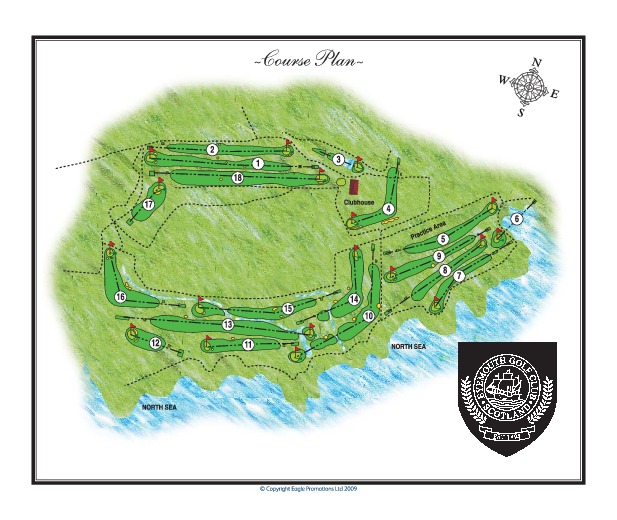
The first course that I've visited again is Eyemouth GC, an 18 hole gem sited on cliff tops on the east coast of Scotland, just 10 miles north of the border with England. Eyemouth was founded in 1894 as a 9 hole course but the construction of a new road to Eyemouth Harbour in 1997 created the opportunity for the course to be extended to 18 holes. Eyemouth has 3 main claims to fame.  It's the first course you'll pass on the way up the A1 road from England, it's 6th hole is recognised as the most extraordinary hole in Great Britain and its 13th is, at 656 Yards, the longest hole in Scotland. But it also has another claim to fame, namely that it's as welcoming a club as you'll find. At most clubs, the back tees are reserved for competition play, but here, visitors are invited to challenge themselves against the very back tees on these two special holes.  A refreshing change!

Anyway, I fronted up on 9 May 2018, on a cool, dry but increasingly windy day, when this little course was clearly ready to bare its teeth. The 1st hole is a straight 506 Yard Par 5, with a couple of blind shots over small hills.  Just take the mobile phone mast in the distance as your line and avoid hitting the guys on the 2nd tee, Alan!  That done, an easy par start.  The 424 Yard 2nd (as shown here) was the Stroke Index 2 hole but I was playing it downwind so that was another easy par.


The redesign of the course has created some really good holes, this downhill 146 Yard Par 3 3rd being one of the best.  This would be a tricky hole, in full view of the clubhouse windows, but the addition of a pond in front of the green makes it really challenging. Long is better than short but very long, when the Greenkeeper was passing by, was just embarrassing.  A bogey 4 was OK.  The 4th is why you need to buy a Course Guide before playing. This is a 289 Yard Par, and Stroke Index 18. First time I played it shortly after the course had been extended, I (naturally) pulled out the driver.  I later found the ball when playing the 5th, on the other side of the road that now bisects the course.  Please note - the 4th is a dog leg that requires a 7 iron at most to stay short of bunkers that line the edge of the fairway, before the road takes over!  I played safe this time, but the increasing wind came into play, I was short with my second shot and another bogey was on the card.

The 5th is an easy looking slightly uphill and downwind Par 4, but there's a blind dip in front of the green, just to get you thinking.  By now you'll be anticipating the famous 6th, the most extraordinary hole in Great Britain.  But you've not gone all that way just to play off the Yellow Tee, have you?  No, you go out to the White tee and turn to look at the apparently massive gap in the cliff, with the sea a good hundred feet below, the wall of rock facing you, that sliver of grass and the top of the flag, just visible a formidably long way away.  You're glad that you're at the far end of the course, with no-one watching, until a couple of walkers stop to take in the spectacle.  You're maybe also wondering whether they've seen your first feeble effort with an old ball or whether you can brass it out, claiming you've done the impossible and are now going to play another ball from the easier yellow tee, just for the fun of it.  Please do not wimp out.  The 6th is one of those rare unforgettable holes that you just must play from the very back tee.  Club selection is key, as you obviously need enough to fly the gap, but the green is considerably higher than the tee and there's the wind....!  My 20 Degree Rescue did the job, just, but I was way left, over beside the next tee, so a bogey 4 was the best I could do.  Here are a couple of photos that give a flavour of this terrific hole.


The 7th is a short 324 Yard Par 4, played slightly downhill into the prevailing wind, running along the side of the cliffs.  Club selection is vital off the tee, as a good long  drive runs the risk of running into a deep cleft in the cliff face or if slightly too far right, into a couple of nasty bunkers.  I was happy with my bogey after flirting with a sheer drop to the sea, far below, after a wayward drive. This was my view for the 2nd shot and a landmark photo in my travels.  I've been using a now battered and old Sony Cybershot 7.2 megapixel camera for just about all of my blog photos since 2009, but it's now jammed, with no signs of life, other than an invitation to turn it off and on again, which then repeats itself.  Looks as though it wasn't indestructible after all!   

The next couple of holes start the trek inland and are short Par 4's, up then downhill.  I was out in 39, playing not too badly, but I knew from past Eyemouth rounds that the Back 9 would be more challenging, being almost exactly 400 yards longer, considerably more hilly and with some quirky greens.

The back 9 starts with a really good short Par 5, dog leg right.  A good drive is essential, to leave a second shot that must finish between the burn that crosses the fairway and the pond in front of the 2-tiered green.  It should be an easy enough hole with careful course management, but the wind caught my pitch to the green and blew it sideways left, so I had to settle for a bogey.  The 11th was my least favourite hole at Eyemouth.  At 279 Yards, this Par 4 might look innocuous in the Course Guide, but it's very steeply uphill into the prevailing wind, the green is only 21 yards deep and half of that is so steeply sloped from back down to front that a ball is very unlikely to hold unless it makes the top tier.  I'd hit a decent drive but still needed a 23 Degree Rescue to reach the green, only to see my ball run back down into one of the 3 bunkers defending the green.  This is a really tough hole, so be warned.  The slope on the 12th green is a bit like the 11th, so although this is a short 165 Yard Par 3, you must find the back of the green with your tee shot, played over a deep gulley.  The wind again came into play and I needed a my Driver to get there.

The 13th is Eyemouth's second signature hole an epic roller coaster Par 5, played downwind and downhill, with a water hazard running alongside the left of the fairway, culminating in a large pond in front of the green.  It's pretty meaty off the Yellow tee, at 590 Yards, but there was ample land behind and above the Yellow and White tees when the course was remodelled, so there's now a tiger tee at the highest point of the course, turning this into a 656 Yard monster. The longest hole in Scotland? I think so and if you ever play Eyemouth, be sure to take the walk and play this hole from the tiger tee, just for fun.  The  panoramic view from the tee is stunning and if you can nail your drive and the wind is helping, you'll be hitting one of your longest ever drives!  The second shot might be blind but the fairway was generously wide and left me with an unlikely chance of reaching the green in regulation, or laying up short of the pond.  I took the conservative approach and was happy enough with a 6.  A great hole! The 14th offers some relief and is an easy enough short Par 4, dog leg left, slightly uphill.  Easy enough if you find the right level on the 2-tier green, that is!  I just missed birdie after a good short iron approach.  

The 15th is the Stroke Index 1 hole and at 441 Yards, is the longest Par 4 at Eyemouth.   Another hole played uphill into the prevailing wind with a steeply sloping green and just to make it even trickier, a burn splitting the fairway that comes into play for your second shot.  I managed a 5 but in truth, I could probably play this hole many many times without getting a par.  The 16th should be relatively straightforward, but in the 6 or so times I've played this course, I don't remember ever getting a par.  The key is to position the tee shot at or beyond the corner of the dog leg, leaving a short iron to a plateau green, well defended by 3 deep bunkers.  I got the first bit right but found an awful lie in one of the bunkers with my second shot and trudged up the hill to the short 17th debating how I'd managed a double bogey!  The 17th is an inviting short Par 3, played over a small gulley, with banking behind the green to catch anything overhit.  An easy par and on to the last hole, a really good 530 Yard Par 5, played downwind.  Keep your drive to the left side of the fairway and be careful not to over hit your approach to the green, as seen here (a photo "borrowed" from an internet source).  I was nearer to the practice putting green after doing just that, hence my closing bogey!

I'd gone round in 84, net 74, with 32 putts.  The composite course I played was around 6300 Yards, Par 72, so a pretty good round in the circumstances.  I'd bogeyed both of the signature holes, but they'll both live long in the memory. It's a pity that Eyemouth doesn't get the huge visitor numbers it deserves, as it's great fun to play, even if your game isn't up to the challenge of some epic holes and sloping greens.  Do yourself a favour and give it a try, with a spare ball or 3 for your shots from the 6th back tee! 


Monday, 18 September 2017

Ardfin Golf Course - Course No 670


Yes, it's been a very long time since my last blog entry.  One reader was concerned that I had either given up the quest to play every course, or that my health was somehow fading to the extent that I could no longer play.  The simple truth is, I've been busy so other pressures on my time have made it very difficult to maintain my progress. Indeed, now that I've played all of the courses that the sports governing body (Scottish Golf) recognises, (see my blog entry from 8 March 2017) most of the smaller and unofficial courses still on my "to play" list are remote and/or difficult to access.

Although the number of golf courses in Scotland is declining as a consequence of a general reduction in playing numbers, the good news is that the development of new courses is continuing, despite that trend.  I'd read  great things about the new course being constructed on the island of Jura, so I was delighted to be invited by the Director of Golf at Ardfin Golf Course to join a small party of guests to play the course on 15 September 2017, meet the Bob Harrison the course architect and offer some thoughts from a playing perspective about the design and lay out.  I got that invite through occasional work that I do for the Top 100 Golf Courses website, so a great big thanks goes to them and to all at Ardfin for making that possible.

So, is Ardfin really as good as recent publicity suggests?  I'd not really known what to expect, aside from a rugged challenge on a great site, but I was simply blown away by the grandeur of the setting, the outstanding quality of the design and some really epic views (and the 30 mph NNW wind that swept across the course!) Time will tell whether Ardfin gets a mention in the world's top 100 one day, but even at this relatively early stage in its evolution it's clearly a contender for recognition as an outstanding new course.  It's maybe unfair to rank it in comparison with other Scottish and UK courses before it's even completely finished and fully open for play, but recent publicity about the course has been right to highlight its quality and potential. I've played all of the famous Scottish courses that attract national and international praise, and given time, Ardfin will join them.  This is a view from the practice ground, down to the 1st tee, looking north, up the Sound of Islay, with Islay in the background.

The back story is already well known. Australian multi-millionaire buys 15,000 acre Scottish estate and comes up with the idea of developing a championship-level golf course, despite the original site being hugely challenging. Exposed peat-based moorland, where weather conditions can be hugely challenging (and that's sometimes in the summer too) is not the most obvious site for a new course, but hat's off to the owner's vision and determination to go ahead. When we met Bob Harrison, the architect engaged to turn the owner's dream into reality, Bob said he'd received a call one day, completely out of the blue, inviting him to "build me a Scottish golf course."  It wasn't a wind-up by a friend, and several years later and 29 return trips from Australia, Bob is now putting the final touches to the project, including some possible new tee locations and reviewing other design details.  This is me, with Ran from the USA, Dick from Holland, and Christian from Denmark with Bob (on the far right) before we set off on our Ardfin game. It's not very often that someone with my limited golfing ability (11 handicap now!) plays in front of an audience so, it was a new experience playing in front of the course architect, Chris the Director Golf, Willie the Estate Manager and Simon the Head Greenkeeper. Factor in that Christian is a former European Challenge Tour pro and that we were later joined by Fergal O'Leary (surely the only man to have played all of the World's Top 100 courses and a formidable player in his own right) and I was way out of my comfort zone!  I needn't have worried, as this was a round which I'll recall as one of the great highlights of my personal journey around Scotland's courses.

Ardfin is a 6800 Yard Par 72 off the Black tees and a "more manageable" 6445 Yarder off the Yellow Tees.  Not overly long but it proved to be hugely difficult on the day.  I played Ardfin off the Yellows on most holes, so it  started with an uphill 398 Yard Par 4. Bob advised us to keep our drives to the left, opening up the best approach to the green. I missed the fairway by inches on the right and could only scramble a double bogey after 3-putting the green.  As we were to discover, the greens were fast running and true, with surfaces that were just outstanding.  Next came the glorious 2nd, a 195 Yard Par 3 over a clifftop ravine, as shown here.  Bob's design approach was to keep the layout sympathetic to the surrounding landscape, keep bunkering to MacKenzie styling and allow bale out areas where possible. There was no such relief on the 2nd and although I managed to clear the ravine OK, another double bogey followed after a fluffed chip from the front of the green.

The Stroke Indexing hasn't been done yet, but I suspect that the 341 Yard Par 4 3rd hole will be one of the easier holes.  I'd hit a reasonably good drive but the fairway slopes down towards the green and I'd not noticed the sucker pin position just before a slope which took 3 of our balls down banking at the back of the green.  Another double for an increasingly nervous Alan.  The tee shot on 4 is the only fully blind shot on Ardfin and we played this short but uphill Par 5 in a sudden downpour that blew up from seemingly nowhere.  Uphill Par 5s in pouring rain often herald personal disaster but 3 good long shots, a chip to 4 feet and a dodgy putt later, and I'd got my first (and only, as it turned out!) par. Next came Holes 5 and 6, which run parallel to each other.  With an OOB wall on the right and most of Jura on the left, the uphill 5th looked easy enough but factor in the NNW wind and this short Par 4 was a real challenge.  The 6th is steeply downhill, as shown here, with another OOB wall intruding from the right.  Left off the tee is safe but leaves a tricky approach to a plateau green.  I decided on a brave line off the tee but pulled my approach way left, for my first lost ball of the round (and there would be many more!)

I lost another ball on the 7th, the last hole on the south section of the course.  The rest of the course lies to the north and dips down to the shore before climbing gradually higher, finishing close to the new hotel being built within the estate, with superb views out to sea.  The transition between those sections of the course was a little awkward, and a good example of the finishing works still to be done before the course can be fully open for play.  This is the 8th, a lovely little Par 4 of only 309 Yards. I'd only a short upwind iron to the green but I didn't have enough club, so another lost ball. As we were all finding to our cost, any misjudgment of line or length could be heavily punished.  I dropped another ball and saw my ball land in the fringe grass beyond the ravine but again, another lost ball.  My score by this time had already assumed catastrophic proportions but I wasn't really caring.  Just as well! 

Earlier in the day the boss of the construction company building the course was telling me that Ardfin would not be revealing its secrets on a first play and that if we thought that we'd just seen the best looking hole on the course, another would be even better and that this was particularly true of the Par 3s.  I'd really liked the 2nd, but the 10th was just incredible. The card said 177 yards off the Black tee and 174 off the Yellow, so as a short hitter (its a long story but illness last year has taken its toll) I was already wary.  The Black tee sits on a narrow strip of land around 15  by 15 feet wide, with a precipitous 100 foot+ drop on 3 sides. The green is the shallow slither just visible below the boathouse roof in the far distance. There is a bale out area but this is hidden from view so it looked as though our only shot was to take on the 170 Yard carry, directly into the 30 mph wind.  I don't think any of us completed the hole without losing a ball.
I'd wimped out by playing from the yellow tee but even with this marginally shorter approach, my view from the tee (as below) didn't look any easier.


And so to the magnificent 11th, which I thought was one of the best and most inviting tee shots on the course.  This is a sweeping right to left dogleg that hugs the shore, with green lying just above seas level, by the boathouse that now forms the luxurious half way house.


The tee shot is pretty demanding.  I'd hit a decent drive but the carry required for the second shot looked impossible, given the wind we faced.  The course is built on an exposed site so if you're lucky enough to play here some day, you might have a different wind to face.  NNW is far removed from the prevailing SW wind so maybe the 11th will be kinder to you. Then again, chances are you'll be battered from another direction!

Chances are you'll also enjoy lunch before tackling the Par 3 12th as seen here from the heights of the 16th fairway.  From the tee, this hole looked relatively simple and at 145 Yards looked well within my range.  However, the NNW wind cut across the hole from left to right.  Christian's ball sailed off right so it was no surprise that my feeble attempt at holding a draw against the wind ended up on the beach.


A double bogey without a lost ball via the beach was actually a decent result. A terrific hole!

The next couple of holes follow the shoreline before the course turns for home.  As before, accuracy off the tee is essential but for me at least, forced layups came into play, since were were still heading into the aforementioned wind.  

The homeward and largely downwind holes offered some relief but by then any semblance of rhythm and tempo in my swing had been replaced by an anxious thrash at the ball aimed at finishing a hole without further loss of golf balls.  Sadly, the harder I tried the worse I got, but I didn't really care. On lesser courses I'd have a big black cloud overhead and grow increasingly frustrated. At Ardfin, I was too busy enjoying the company, the views and the golf course itself.  This is the 16th, an excellent 492 Yard Par 5 that played short enough to suggest it would be another of the easier holes - must be, since I didn't lose a ball!

The course finishes with another Par 5, this time a 523 Yarder that's steeply uphill.  Ran managed a great birdie here, which he would later talk us through with great relish! Me?  I resisted the temptation to talk our party through my lamentable "umpteen" with 2 lost balls. I'd suffered enough.  The 18th finished with this excellent view out to sea, from what felt like almost the highest point of the course.  It had been a truly epic round, with great company and for me, a sympathetic audience.  I've played better, in fact I can't remember playing much worse. However, I can't remember enjoying playing badly so much in all of my travels.  That's maybe a curious measure to judge a course by, but that'll do for me.  Ardfin was just a joy from hesitant start to ignominious finish. 

We'd time after our round to have a look at the hotel under construction and a new design departure for Bob, the 9 hole pitch and putt course taking shape in front of the hotel.  As regular readers of this blog will know by now, Craig, Stu and I include pitch and putt courses in our list of courses to play in pursuit of our quest.  So, having played the Ardfin course, I'll want to get back to Jura some time to play this little course.  That's one for the future and by then the future usage and accessibility of the new Ardfin course will no doubt be clearer.  As matters stand, it's not clear whether the course will be open to the public.  I hope so, since Bob's design deserves wider praise and the owner deserves wider recognition for his determination to build such a high quality course in such a wild and challenging landscape. Jura's unchanging remoteness means that even if the course is opened for visitors to enjoy, it would never be overrun, so maybe other fellow golfing travellers will get the chance to experience Ardfin at its very best, wind and all!

Thank you again to all who helped make my visit to Ardfin so enjoyable.  And Ran, remind me about that closing birdie again sometime!!