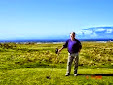
This course is located in the grounds of Dalmeny House, the ancestral home of the current Earl of Rosebery, just outside the west side of Edinburgh on the shores of the Firth of Forth. The course is only played by members of the Dalmeny House GC (primarily estate workers) and their guests, so getting access here depends on being invited by a member of that club. Thankfully, Graeme our latest new friend and supporter knew a member, so Douglas, Graeme and I fronted up on 3 July 2014 to meet Martin, the most congenial of hosts, who very kindly enabled us to play this very exclusive private course. I'd seen the course quite a few times from the air, as Dalmeny House is just north of the flight path into Edinburgh Airport when landing from the east, and there's an excellent coastal walk that takes walkers past the course, so it was great to see the course up close for the first time. This is a view from the 1st tee back to the House and the 9th green.
 This 9 hole parkland course measures 2251 Yards Par 31 off the Yellow tees and is pretty flat and easy walking. The 1st hole should be easy enough, as it's a 280 Yard Par 4 with the widest fairway you could wish for. That's also the hole's main defence. The fairway is so wide and featureless that it's difficult to focus on a line. I opened with a hooky 200 Yard drive and had just a short pitch to the green - which I somehow managed to miss! A bogey 5 was poor. Next, a formidable 231 Yard Par 3, as shown here. The green slopes wickedly downhill from right to left and with the hole positioned awkwardly at the top of a steep slope on the green, the last place I wanted to be off the tee was front right, just short of the green. Only the most cautious and accurate pitch would rescue par. Double bogey was not on the game plan but the company was good and we weren't really concentrating too well. That's my excuse anyway.
Next, a 290 Yard Par 4 that should have yielded my first par of the day after a good drive. Sadly, a poor sand iron pitch led to another bogey. The 4th is a 172 Yard Par 3, played almost blind over a small hillock just in front of the green, covered in long shaggy grass. Only the very top of the flag is visible from the tee, so a decent 23 Degree Rescue through the back of the green and a good pitch to under a foot set up an easy opening par. The 5th, as shown below, is probably the best hole of the course, a 397 Yard Par 4 that's rightly rated the Stroke Index 1 hole. A line of trees across the left side of the fairway comes into play off the tee. You can go right off the tee to leave yourself with a clear shot to the green but this would take you perilously close to the shore line, so I figured that laying up short would leave me with with a mid-iron over the trees to the green. I just clipped the very top of one of these trees and a 9 iron from medium rough left me just short of the green. Another good pitch and run to under a foot gave me a tap in bogey, but this was a good interesting and very tough hole.


The 6th is a 245 Yard Par 3 that I suspect is well outside most Dalmeny Estate GC members' capabilities. I'd hit a good drive but was still short and after a duffed shot needed yet another good pitch to rescue a bogey. The 7th is a 188 Yard Par 3 that demands a dead straight drive through a narrow gap between mature trees. I was only a few degrees left of ideal but found one of the trees and needed another good scramble to rescue a bogey.
 The 8th is played in front of the House, as shown here, and is a 312 Yard Par 4. The fairway is as wide as you could wish for and after a good drive I'd just a short wedge to the green. An easy par and a good opportunity to see the House close up and admire the view out to the Firth of Forth, including the small islands of Inchcolm and Inchkeith. And so to the last, a slightly uphill 136 Yard Par 3 that played a lot longer than it looked. I opted for an easy 27 Degree Rescue and managed a couple of putts for a closing par. A gross 38, net 32.5 with 14 putts was not bad but as Martin rightly advised, scoring low around here is really difficult. There are 5 Par 3s but each of them are tricky in their own right, with 2 of them being out of reach for most golfers (bearing in mind that this is a parkland course with fairways that I suspect are usually pretty slow).
Here are a couple of views of the 9th hole, first from the tee and second, looking back towards the Firth, with Fife in the background.


We'd obviously played the Summer course on 3 July. The club members use a completely different Winter course from September each year, played to the same 9 greens in a different sequence from different tees, so there are actually 2 courses here. Martin has very kindly invited us back to play the Winter course, so I'm looking forward to that. It was a privilege to play this private courseand it will be interesting to compare the Summer and Winter layouts. I just hope the Par 3s are a bit easier!